
30 Easy Ways to Save Energy Without Breaking a Sweat
Why Learning 30 Ways to Save Energy Can Cut Your Bills by Hundreds of Dollars
The 30 ways to save energy that make the biggest difference at home are:
- Set your thermostat back 7–10°F for 8 hours a day
- Switch to LED bulbs
- Unplug devices and use smart power strips
- Wash clothes in cold water
- Line-dry laundry instead of using the dryer
- Use natural light (open curtains in winter, close them in summer)
- Run the dishwasher only when full
- Set your water heater to 120°F
- Seal air leaks around doors and windows
- Clean or replace HVAC filters every 90 days
- Install low-flow showerheads
- Take shorter showers
- Set your fridge to 35–38°F and freezer to 0°F
- Use a microwave or toaster oven instead of a full-size oven for small meals
- Insulate your water heater with a blanket
- Seal and insulate air ducts
- Turn off ceiling fans when you leave the room
- Use a programmable or smart thermostat
- Upgrade to ENERGY STAR appliances
- Insulate hot water pipes
- Cook with lids on pots
- Air-dry dishes instead of using heat dry
- Plant trees strategically for shade and wind protection
- Use power strips to eliminate phantom loads
- Clean refrigerator coils twice a year
- Insulate your attic
- Weatherstrip doors and windows
- Reverse ceiling fan direction seasonally
- Use a slow cooker or electric kettle instead of the stovetop
- Schedule a professional energy audit
Energy costs keep climbing. The average American household now spends roughly $1,900 a year on utility bills — and a big chunk of that is simply wasted.
Lights left on. Devices silently drawing power. Warm air sneaking out through gaps you can’t see. It adds up fast.
The good news? Most of the fixes are cheap — or completely free. Some take less than a minute to do. And when you stack them together, the savings are real.
For example, just adjusting your thermostat by 7–10°F for eight hours a day can trim your annual heating and cooling costs by up to 10%, according to the U.S. Department of Energy. Switching to LED bulbs alone can save the average household around $225 a year. And phantom power — the energy your devices silently consume while “off” — costs most homes about $100 a year without anyone noticing.
This guide walks through 30 practical, proven ways to reduce your energy use — from zero-cost daily habits to smart upgrades that pay for themselves quickly. Whether you’re trying to cut your monthly bill, reduce your carbon footprint, or move closer to energy independence with solar, there’s something here you can act on today.
Immediate No-Cost Habits to Slash Your Bills
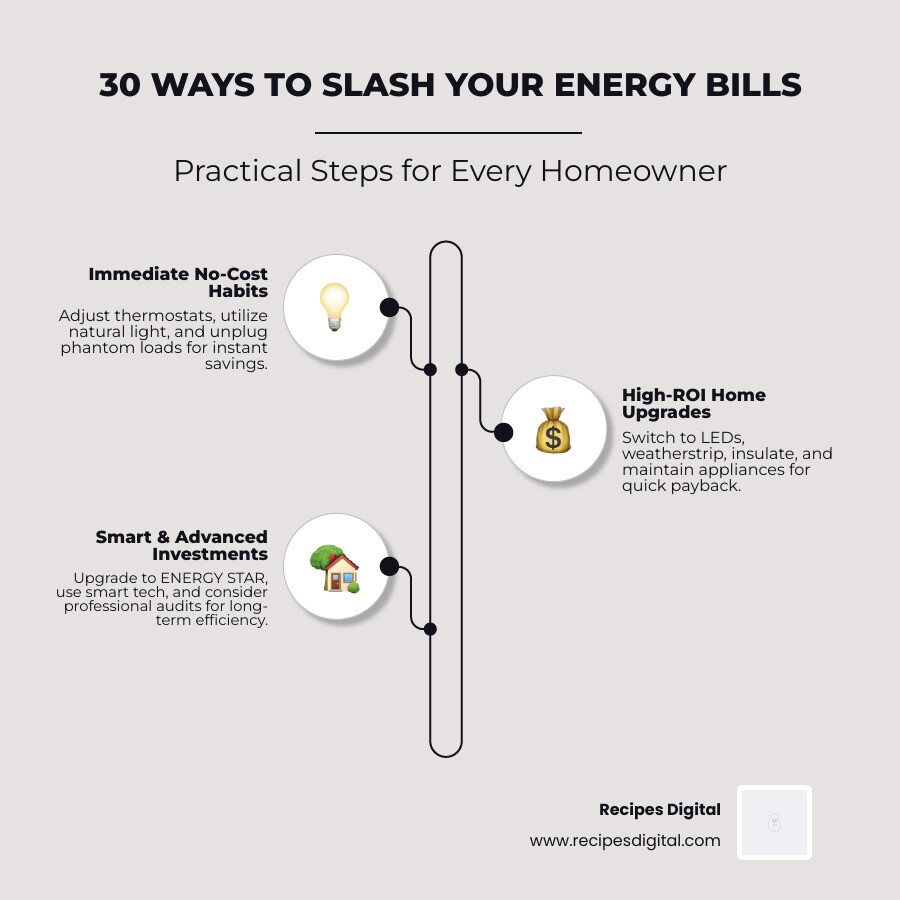
We often think saving energy requires a massive renovation, but some of the most effective 30 ways to save energy don’t cost a single penny. They just require a shift in how we interact with our homes.
Master the Thermostat Setback
Heating and cooling account for roughly 50% of your total energy bill. One of the easiest habits to adopt is the “setback.” By turning your thermostat back 7–10°F from its normal setting for just eight hours a day (like when you’re at work or sleeping), you can cut your annual HVAC costs by up to 10%. In the winter, try aiming for 68°F while home and lower when away; in the summer, 78°F is the sweet spot for efficiency.
Let the Sun Do the Work
“Smart daylighting” is a fancy term for using your curtains correctly. During April 2026, as we transition through spring, this is vital. In the winter, keep south-facing drapes open during the day to let the sun heat your home for free. In the summer, close them to block that heat. This simple habit can reduce lighting and climate control costs by 10–40%.
Cold Water and Fresh Air
Did you know that 90% of a washing machine’s energy goes toward heating the water? Switching to cold water for your laundry can eliminate about 1,600 pounds of CO2 emissions per year and significantly lower your bill. Once the clothes are washed, skip the dryer. Clothes dryers account for about 6% of household electricity. Line-drying your laundry, even just part of the time, makes a noticeable dent in your consumption.
Combat the “Vampire” Drain
Many of our electronics never actually turn off. They stay in “standby mode,” waiting for a signal. These phantom loads account for 5–10% of a typical home’s electricity use. Unplugging chargers, coffee makers, and game consoles when not in use is a no-cost habit that keeps roughly $100 in your pocket every year.
High-ROI Investments and 30 Ways to Save Energy
If you have a small budget to work with, these investments offer the best “bang for your buck.” We focus on these because they pay for themselves in months, not decades.
The LED Revolution
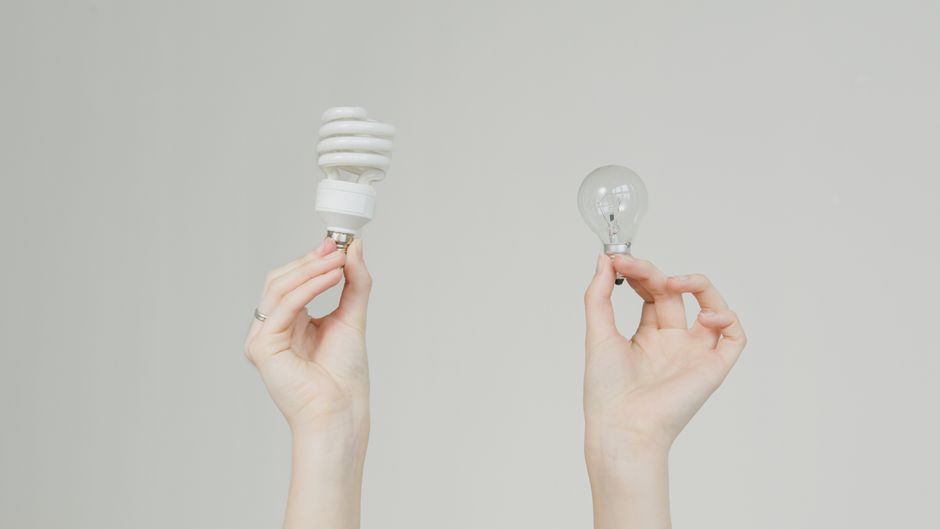
Residential LEDs use at least 75% less energy and last up to 25 times longer than old-school incandescent bulbs. Traditional bulbs waste 95% of their energy as heat! Replacing your five most-used light fixtures with LED bulbs can save you significantly over the year.
Low-Flow, High Savings
Water heating is usually the second-largest energy expense in a home. By replacing one standard showerhead with a WaterSense-labeled model, an average family saves about 2,700 gallons of water and 330 kWh of electricity annually. That’s enough energy to power a refrigerator for months!
Sealing the Envelope
Your home is like a living organism that needs to stay sealed. Air leaks around doors, windows, and utility gaps can waste 5% to 30% of your energy.
- Weatherstripping: A simple DIY project that costs less than $50 but can save 10-20% on heating and cooling.
- Attic Insulation: If you can see your floor joists in the attic, you probably need more insulation. Proper insulation can reduce your heating and cooling needs by up to 30%.
Upgrade to ENERGY STAR
When it’s time to replace an old appliance, look for the blue ENERGY STAR label. These appliances are tested to be 10–50% more efficient than standard models. Modern refrigerators, for example, use less energy than a 60-watt light bulb! You can find more practical tips from experts to help guide your next home upgrade.
Optimizing Appliances and 30 Ways to Save Energy in the Kitchen
The kitchen is the heart of the home, but it’s also an energy-hungry beast. Here is how we can tame it.
Refrigerator Efficiency
Your fridge runs 24/7, so efficiency is key. Keep it set between 35–38°F and the freezer at 0°F. A full fridge actually stays cold more efficiently than an empty one because the cold items help maintain the temperature when the door is opened. However, don’t overstuff it to the point where air can’t circulate. Also, remember to clean those condenser coils twice a year; dusty coils make the motor work twice as hard.
Dishwasher vs. Hand Washing
Believe it or not, an electric dishwasher uses less than half the energy and significantly less water than washing by hand. To maximize savings, only run it with a full load and select the “air dry” option instead of “heat dry.”
Smart Cooking Choices
Using the right tool for the job is essential. For small meals, a toaster oven or microwave uses roughly 80% less energy than a full-size conventional oven.
| Appliance | Energy Efficiency | Best Use Case |
|---|---|---|
| Microwave | Very High | Reheating, small meals, steaming |
| Toaster Oven | High | Toasting, small batches of veggies |
| Slow Cooker | Medium-High | Stews, bulk meal prep |
| Conventional Oven | Low | Large roasts, multi-rack baking |
| Electric Kettle | High | Boiling water for tea/cooking |
Seasonal Maintenance and 30 Ways to Save Energy Year-Round
Regular maintenance keeps your systems running at peak performance, preventing them from “working overtime” and wasting electricity.
HVAC Filter Love

A clogged filter restricts airflow, forcing your system to use more power. Regularly cleaning or replacing your HVAC filter every 90 days (or monthly during peak summer/winter) can lower your air conditioner’s energy draw by 5–15%.
Duct Sealing
In a typical house, 20–30% of the air that moves through the duct system is lost due to leaks, holes, and poorly connected ducts. Sealing these gaps with mastic or metal-backed tape can save you 25-40% on your HVAC energy use. It’s one of the most effective ways to slash your costs.
The Ceiling Fan Trick
Ceiling fans cool people, not rooms, by creating a wind-chill effect. In the summer, run them counter-clockwise to push air down. In the winter, reverse the direction to clockwise at a low speed; this pulls cool air up and pushes the warm air trapped at the ceiling back down to you. This simple switch can save up to 15% on heating bills.
Landscaping for Efficiency
Strategically planting deciduous trees (trees that lose leaves in winter) on the south and west sides of your home can provide shade in the summer, reducing cooling costs by up to 25%. In the winter, the bare branches allow the sun to shine through and warm your home.
Advanced Efficiency and Water Heating Optimization
Once you’ve mastered the basics, it’s time to look at the “pro” moves. These involve slightly more technical adjustments but offer massive long-term rewards.
Lower the Temperature
Most water heaters are set to 140°F by default, which is hot enough to cause third-degree burns. Lowering the setting to 120°F is safer and can save you 6–10% in water heating costs. If your water heater is in an unheated space, consider an insulating blanket to reduce “standby” heat loss by 25–45%.
Tankless and Heat Pump Technology
If your old water heater is nearing the end of its life, consider a tankless (on-demand) heater or a heat pump water heater. Tankless models can be 30–50% more efficient because they don’t keep 50 gallons of water hot all day when you aren’t using it.
Smart Home Integration
As we move further into 2026, smart home technology has become incredibly accessible.
- Smart Thermostats: These learn your schedule and automatically adjust for maximum savings.
- Energy Monitors: Devices that clamp onto your breaker panel and show you exactly which appliance is hogging electricity in real-time.
- Smart Plugs: These allow you to set timers for lamps or completely cut power to “vampire” devices via an app.
Solar and Battery Storage
At Recipes Digital, we believe the ultimate goal is energy independence. Modern solar panels combined with solar battery storage allow you to capture energy during the day and use it at night, effectively “shaving” the peak off your utility bill. With federal tax credits still available in 2026, the ROI for these systems is better than ever, often paying for themselves in 7–10 years while providing backup power during outages.
Frequently Asked Questions about Saving Energy
How can renters save energy without permanent modifications?
Renters have plenty of options! You can achieve 15–25% savings through non-permanent changes:
- LED Swaps: Keep your old incandescent bulbs and swap them back when you move out.
- Removable Weatherstripping: Use “rope caulk” or foam strips that peel off easily.
- Thermal Curtains: These block heat in summer and keep it in during winter.
- Smart Power Strips: Plug your TV and gaming console into one to kill phantom power with one switch.
What is the best way to involve children in energy saving?
Make it a game! We love the idea of a “shorter shower challenge” where kids try to finish their shower before a favorite five-minute song ends. Teaching them to turn off lights when leaving a room builds lifelong habits. You can even print out a poster for them to color that lists these energy-saving goals to keep the family motivated.
How do I measure and track my personal energy savings?
The best way is to look at your utility bills year-over-year (comparing April 2025 to April 2026, for example). Many utility companies now provide “Smart Meters” that allow you to log into a portal and see your usage by the hour. If you want to get serious, a professional energy audit is the gold standard; an expert will use thermal cameras to show you exactly where your home is leaking money.
Conclusion
Saving energy isn’t just about sacrifice; it’s about being smarter with the resources we have. By combining these 30 ways to save energy, you create a cumulative effect that significantly lowers your bills and your environmental footprint.
At Recipes Digital, we are dedicated to providing you with the digital resources you need for modern, sustainable living. Whether you are looking for advice on the best solar batteries, tips on installing panels, or just simple accessories to make your home more efficient, we are here to help.
The transition to a more efficient home starts with a single step—maybe it’s turning down the water heater or switching a light bulb today. Every small change adds up to a brighter, more sustainable future for all of us.
