
Shine a Light on Your Savings with Home Solar Energy Kits
Is a Home Solar Energy Kit Right for You?
Home solar energy kits are complete, ready-to-install packages that let homeowners generate their own electricity from sunlight — at a fraction of the cost of hiring a traditional solar company.
Here’s a quick snapshot of what you need to know:
| Question | Quick Answer |
|---|---|
| What’s included? | Solar panels, inverter, racking, wiring, and often a charge controller |
| Types available | Grid-tied, off-grid, and hybrid |
| Typical cost | $1.30–$1.55 per watt with incentives (DIY) |
| DIY savings | 40–50% less than full-service installation |
| Federal tax credit | 30% off total system cost |
| Payback period | 5–8 years for grid-tied systems |
| Panel lifespan | 25–30 years |
Electricity bills keep climbing. Power outages feel more common. And full-service solar installs can cost tens of thousands of dollars before incentives.
That’s exactly why more homeowners are turning to DIY solar kits.
The good news? A quality home solar kit gives you everything you need in one box — engineered components that work together, permit-ready documentation, and enough guidance that even first-time installers can get it done.
The even better news: the federal government covers 30% of your system cost through the Solar Tax Credit, and DIY kits are fully eligible.
Whether you want to slash your monthly bill, prepare for outages, or move toward full energy independence, there’s a kit sized for your needs — from compact 3kW starter systems to whole-home 15kW+ setups.
This guide breaks down the types of kits available, what they cost, how to size one for your home, and what to expect when you install it yourself.
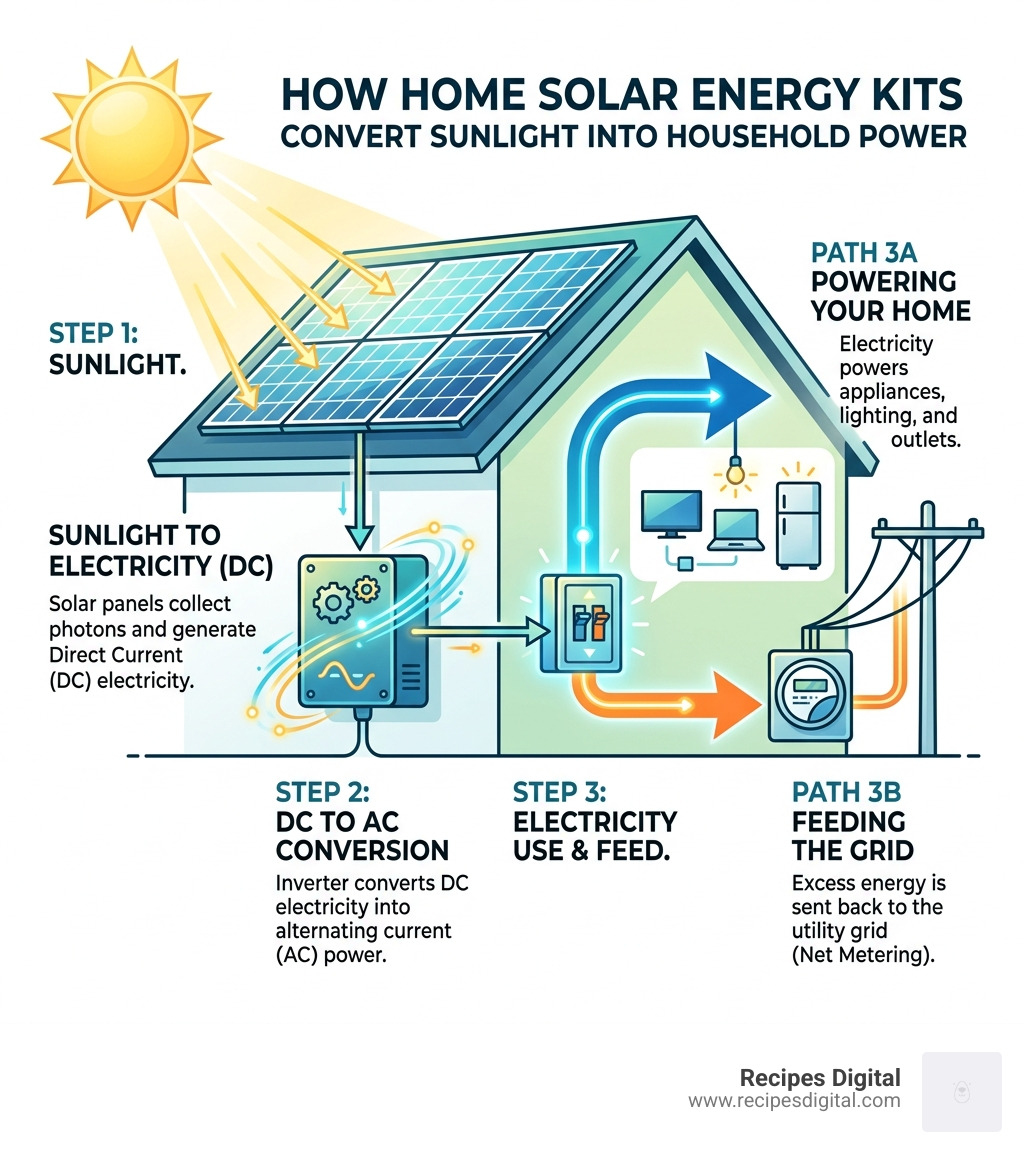
Understanding the Different Types of Home Solar Energy Kits
Before we dive into the nuts and bolts, we need to talk about how your system talks to the world. Not all home solar energy kits are created equal; they are generally categorized by how they interact with the local utility grid. Choosing the right one is the first step toward your energy-independent future.
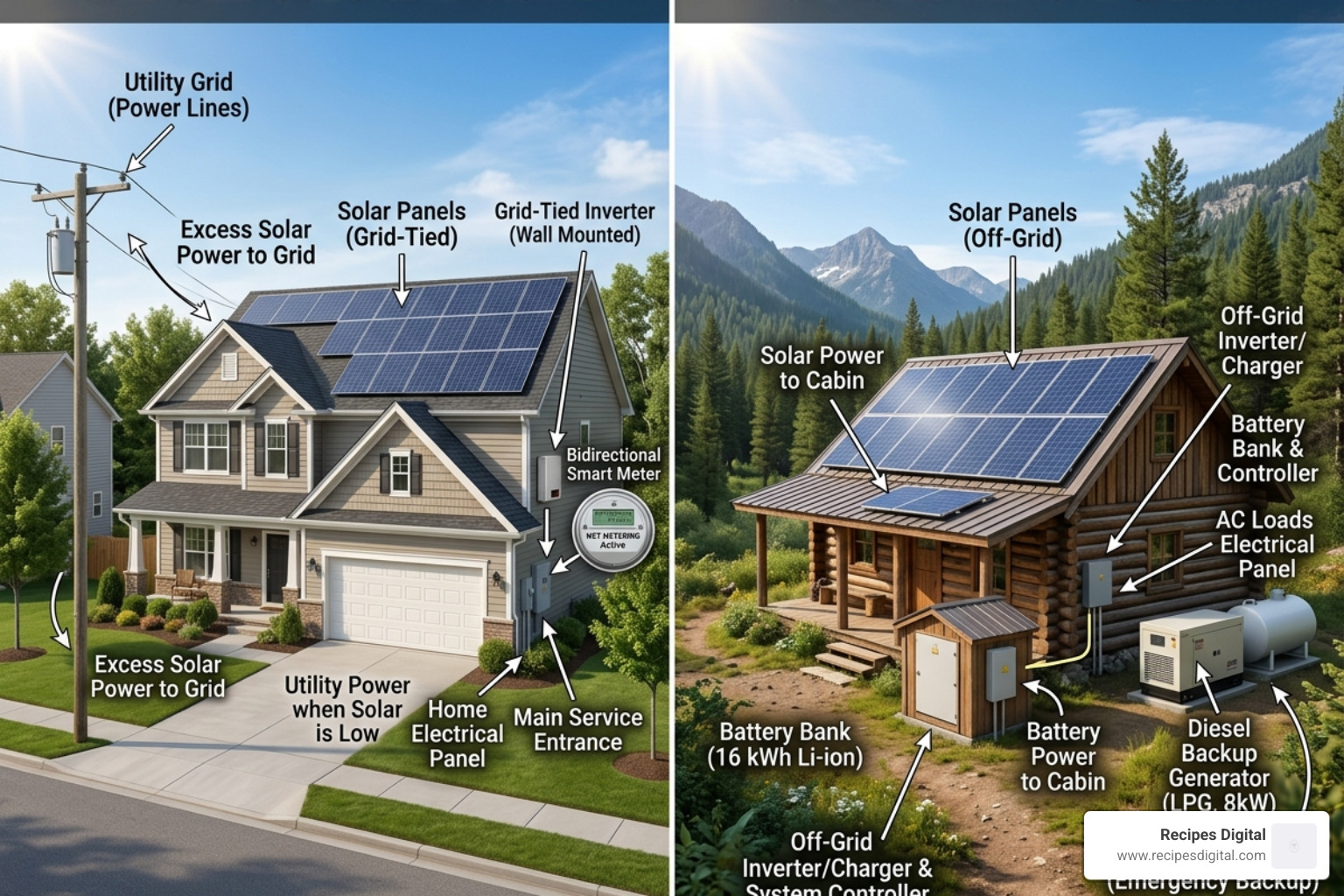
Grid-Tied Systems
The most common and cost-effective choice for suburban homeowners is the grid-tied system. Think of the utility grid as a giant, communal battery. During the day, your panels produce energy. If you produce more than you use, the excess flows back to the grid, often earning you “net metering” credits. At night, you pull energy back from the grid. It’s a seamless two-way exchange that effectively “spins your meter backward.”
Off-Grid Systems
If you’re building a cabin in the woods or want to say a permanent goodbye to the electric company, off-grid is your path. These kits are entirely independent. Because there is no grid to lean on, these systems must include a robust battery bank (usually Lithium or Lead-Acid) to store power for nighttime and cloudy days. They are the ultimate solution for survivalists, homesteaders, and remote explorers.
Hybrid Systems
Hybrid systems are the “best of both worlds” option. They remain connected to the grid (allowing for net metering) but also include battery storage. This provides blackout protection—when the grid goes down, your lights stay on. In April 2026, we are seeing more homeowners opt for hybrid setups to avoid “peak demand” charges from utilities, using their stored battery power when electricity rates are at their highest.
Scientific research consistently shows that residential solar benefits go beyond the wallet; they reduce the strain on local aging infrastructure and significantly lower the carbon footprint of the average household.
Grid-Tied vs. Hybrid: Which is Right for You?
Choosing between a standard grid-tied kit and a hybrid one usually comes down to two things: your budget and your tolerance for blackouts.
- Grid-Tied is the “Bill Killer.” It is the most affordable entry point and offers the fastest Return on Investment (ROI), typically paying for itself in 5–8 years. However, for safety reasons (to prevent back-feeding the grid while workers fix lines), most grid-tied systems shut off during a power outage.
- Hybrid is the “Security Guard.” It’s a “battery-ready” system. Even if you don’t buy the batteries today, many modern hybrid inverters allow you to plug them in later. This setup offers peace of mind, ensuring your refrigerator and Wi-Fi keep running during a storm.
Essential Components of a Complete Solar System
When you open your home solar energy kits, it can feel like a giant Lego set for adults. But don’t worry—every piece has a specific, vital job. We ensure that our resources at Recipes Digital help you understand these components so you can install them with confidence.

- Solar Panels: Usually high-efficiency monocrystalline panels. These are the “workhorses” that catch the photons.
- Inverters: These convert the Direct Current (DC) electricity from your panels into the Alternating Current (AC) used by your toaster and TV. You’ll choose between microinverters (one small inverter per panel) or string inverters (one large central box).
- Racking Hardware: This is the “skeleton” of your system. Whether it’s flush-mounts for an asphalt roof or a ground-mount for your backyard, this keeps your panels secure against 100mph winds.
- Charge Controllers: (Mainly for off-grid/hybrid) These act as the “brain,” managing the flow of electricity to your batteries to prevent overcharging.
- Wiring and Safety Gear: This includes MC4 cables, rapid shutdown devices (for fire safety), and disconnect switches.
Sizing Home Solar Energy Kits for Your Needs
How much power do you actually need? To find out, we recommend a “12-month energy audit.” Look at your utility bills from the last year to find your average monthly kilowatt-hour (kWh) usage. This accounts for the high AC usage in summer and heater usage in winter.
| Kit Size | Typical Monthly Production | Number of Panels (Approx.) | What it can power |
|---|---|---|---|
| 3kW Kit | 225–500 kWh | 8 Panels | Small cabin, lights, fridge, laptop |
| 7kW Kit | 450–1,200 kWh | 18 Panels | Average home, standard appliances |
| 10kW Kit | 800–1,600 kWh | 25 Panels | Large home, multiple AC units, EV charging |
| 12kW Kit | 1,000–2,000 kWh | 30 Panels | Whole-home independence, high-demand loads |
We always suggest adding a 10–20% “system buffer” to your calculations. This accounts for minor inefficiencies like shading, dust, or that extra-long hot shower.
Don’t Blow a Fuse Selecting Your 10A or 30A Solar Controller
If you are building an off-grid or mobile setup, the charge controller is your battery’s best friend. Choosing the wrong size can lead to blown fuses or, worse, damaged batteries.
When you Don’t Blow a Fuse Selecting Your 10A or 30A Solar Controller, you’re looking at the amperage and voltage compatibility. A 10A controller is great for small, portable setups (like a van or a shed), while a 30A or 60A controller is necessary for larger residential battery banks. Always ensure your controller’s voltage matches your battery bank (12V, 24V, or 48V).
The Financial Benefits and Savings of DIY Solar
Let’s talk numbers. The national average cost for a professionally installed residential solar system ranges between $16,870 and $23,170 after incentives. By opting for a DIY home solar energy kit, you can save nearly half of that.
The “DIY Discount”
Traditional solar companies have massive overhead: sales commissions, office rent, and marketing. When you buy a kit, you cut out the middleman. DIY kits are typically priced at $1.30–$1.55 per watt (with incentives), compared to the $2.75–$3.50 per watt charged by full-service installers.
The 30% Federal Tax Credit
As of April 2026, the Federal Solar Tax Credit remains a powerhouse incentive. It allows you to deduct 30% of the entire cost of your system—including panels, inverters, racking, and even the batteries—from your federal taxes. If your kit costs $10,000, that’s a $3,000 straight-off-the-top savings.
Scientific research on solar cost trends indicates that while panel prices have stabilized, the “soft costs” (labor and permitting) are where the most savings are found today. By doing the work yourself, you are capturing those savings directly. Plus, solar installations are proven to increase property value, often by 4% or more, while remaining exempt from property tax increases in many states.
Maintaining Your Home Solar Energy Kits for Longevity
Solar is remarkably low-maintenance because there are no moving parts. However, a little TLC goes a long way.
- Panel Cleaning: Dust, pollen, and bird droppings can drop efficiency by 5–10%. A simple rinse with a hose a few times a year usually does the trick.
- Connection Checks: Once a year, we recommend a quick visual check of your wiring and racking to ensure everything is tight and corrosion-free.
- Component Lifespan: Most Tier-1 panels come with a 25-year warranty and are expected to last 30+ years. Lithium (LiFePO4) batteries typically last 10–15 years, while older lead-acid tech only lasts 3–7 years. Inverters generally need a replacement around the 12–15 year mark.
Installation Considerations for Different Roof Types
Where you put your panels matters just as much as which panels you buy. Most home solar energy kits are designed for asphalt shingle roofs, but they are highly adaptable.
- Asphalt Shingles: These use “flashing” mounts that slide under the shingles and bolt into the rafters. When installed correctly with watertight sealant, they are incredibly secure and leak-proof.
- Metal Roofs: Often the easiest to install on! Many metal roofs allow for “standing seam” clamps that grip the roof without ever piercing the surface.
- Ground Mounts: If your roof is shaded or faces the wrong way (North), a ground mount in the backyard is a fantastic alternative. They are easier to clean and stay cooler, which can actually improve energy production.
- Permitting and Safety: Most quality kits now come “permit-ready.” This means they include engineer-stamped plans and wiring diagrams that you can take straight to your local building department. For safety, modern kits include “rapid shutdown” hardware, which allows first responders to de-energize the system instantly in case of an emergency.
DIY-Friendly Skills and Tools Required
You don’t need to be a rocket scientist to install a solar kit, but you should be comfortable with a drill and a ladder.
- The Tools: A standard impact driver, a socket set, a level, and a chalk line are usually all you need for the racking.
- The Skills: If you can follow a manual and understand basic electrical safety (like “red to red, black to black”), you can handle the DC side of the installation.
- The Professional Touch: We always recommend hiring a licensed electrician for the final “tie-in” to your main breaker box. They can ensure your system is up to code and handle the connection to the utility grid, which is often a requirement for your warranty and local permits.
Frequently Asked Questions about Home Solar
Can a solar kit power my entire home?
Yes! A properly sized kit (usually 10kW to 15kW for an average American home) can offset 100% of your energy usage. If you are off-grid, you just need a large enough battery bank to carry you through the night.
How much can I save with DIY installation?
Most homeowners save between 40% and 50% compared to professional installers. On a medium-sized system, this often equates to $7,000 to $10,000 in labor and markup savings.
Are solar kits expandable for future needs?
In most cases, yes. If you use microinverters, adding more panels later is very simple. If you have a hybrid system, you can usually add more battery modules as your budget allows. We always recommend choosing a “battery-ready” inverter if you plan to expand later.
Conclusion
The era of energy independence is no longer reserved for those with $30,000 to spare. With home solar energy kits, the power is quite literally in your hands. By choosing to DIY, you aren’t just saving money; you’re gaining a deep understanding of how your home functions and contributing to a more sustainable, modern energy grid.
At Recipes Digital, we believe that sustainable living should be accessible and straightforward. Whether you’re looking for the perfect battery setup or tips on maximizing your panel’s output, we provide the digital recipes you need for a modern, sun-powered life.
Ready to take control of your utility bill? Start your solar journey with Recipes Digital and shine a light on your own savings today!
