
Hydrogen Battery Storage: Why Your Grid Might Be Running on Gas
What Is Hydrogen Battery Storage and Why Does It Matter?
Hydrogen battery storage is a way to store large amounts of electricity by converting it into hydrogen gas — and then converting it back to power when you need it.
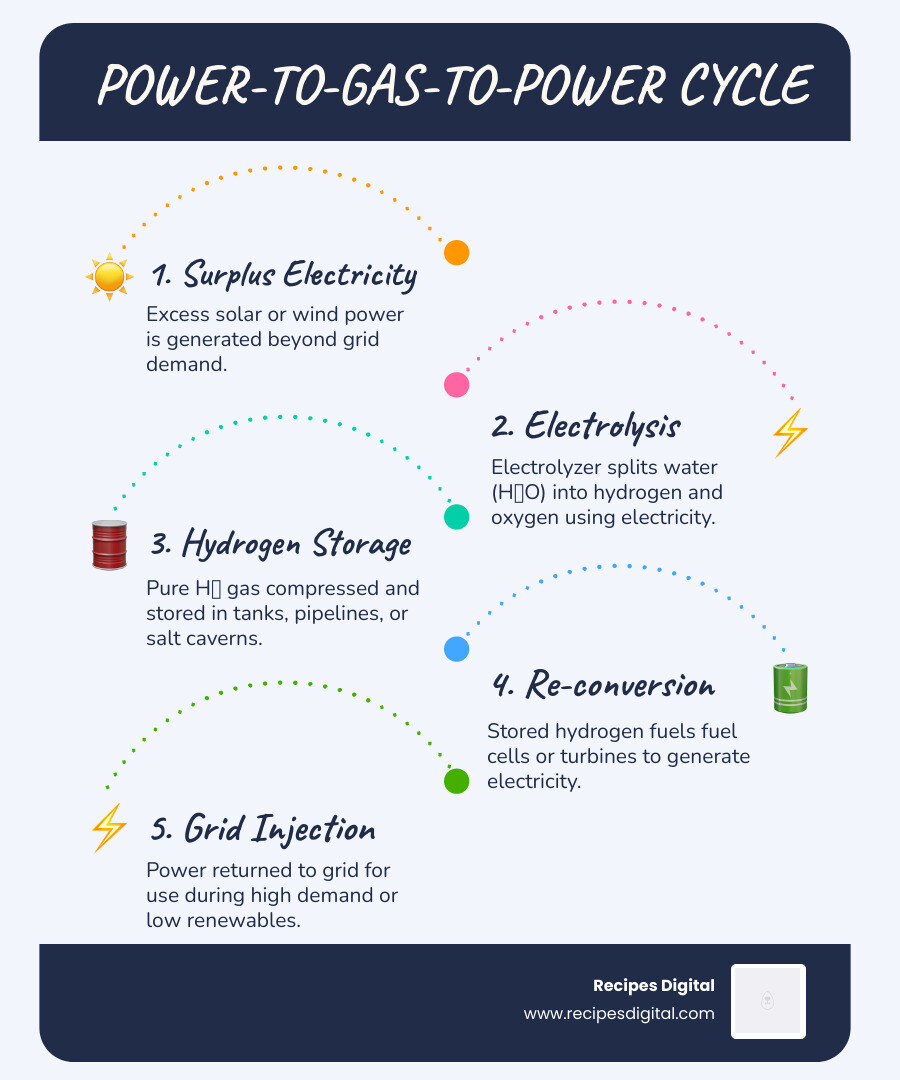
Here’s the quick version of how it works:
- Surplus electricity (from solar or wind) powers an electrolyzer
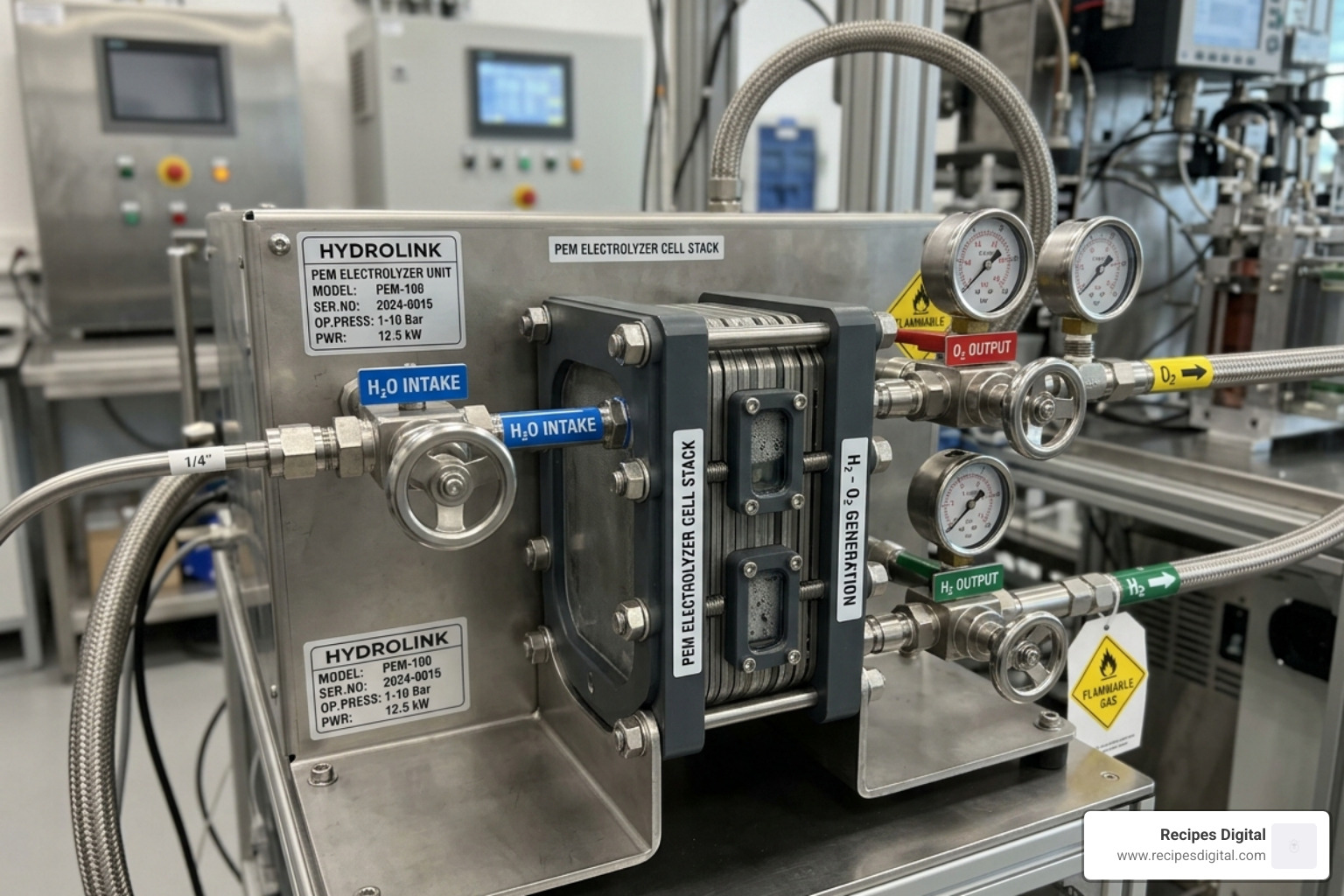
- The electrolyzer splits water into hydrogen and oxygen
- Hydrogen is stored in tanks, pipelines, or underground caverns
- When power is needed, hydrogen is converted back to electricity via a fuel cell or turbine
This makes hydrogen one of the few technologies that can store energy for days, weeks, or even entire seasons — not just hours like a typical lithium-ion battery.
For eco-conscious homeowners and grid planners alike, this matters more than ever. As solar and wind generation grow, so does the problem of what to do with extra energy when the sun is shining and no one needs it — and how to keep the lights on when it isn’t.
Traditional batteries are excellent for short bursts of storage (minutes to a few hours). But for longer gaps — think a week of cloudy weather or a full winter season — they become extremely expensive to scale. Studies project that a fully renewable Europe could need 200 TWh or more of long-duration storage. The entire global supply of lithium could only cover around 470 TWh total. That’s a tight margin.
Hydrogen fills that gap. Salt caverns alone can hold up to 100 GWh of stored electricity in a single facility. And while the technology is still maturing, the economics are shifting fast.
How Hydrogen Battery Storage Works
At its heart, hydrogen battery storage is a chemical process that acts like a massive “reset button” for the grid. While we often think of batteries as solid boxes filled with lithium, a hydrogen “battery” is actually a system of interconnected components that move energy between liquid, gas, and electrical states.
The process begins with “Power-to-Gas.” When our solar panels produce more energy than we can use in the afternoon, that excess power is sent to an electrolyzer. This device uses the electricity to break the chemical bonds of water ($H_2O$), releasing oxygen and capturing pure hydrogen gas.
This gas is our stored energy. Unlike electricity, which is hard to keep still, hydrogen gas can be tucked away for months without losing its charge. When the sun goes down or the wind stops blowing, we initiate “Gas-to-Power.” The stored hydrogen is fed into a fuel cell or a specialized turbine to generate clean electricity once again.
The Components of Hydrogen Battery Storage
To understand the technology behind these systems, we need to look at the three main “stages” of the hydrogen cycle:
- Electrolyzers (The Chargers): These are the engines of the system.
- Alkaline Electrolyzers: A mature technology used for decades in industrial settings. They are reliable and relatively low-cost.
- PEM (Proton Exchange Membrane) Electrolyzers: These are more flexible and can ramp up or down quickly, making them perfect for pairing with the “moody” nature of wind and solar power.
- Solid Oxide Electrolyzers (SOEC): The “next-gen” option. These operate at high temperatures and can reach efficiencies up to 90%, though they are still mostly in the development phase.
- Storage Units (The Tank): This is where the hydrogen sits. It might be a high-pressure tank, a specialized metal hydride “sponge,” or a massive underground salt cavern.
- Fuel Cells and Turbines (The Generators): These convert the gas back into power. PEM fuel cells are common for smaller, decentralized setups, while large-scale grid operations might use hydrogen-ready combustion turbines.
Re-electrification and Grid Injection
Once we have our hydrogen, how do we get the power back? Re-electrification is the most common path. Hydrogen fuel cells can convert the gas back to electricity with efficiencies of about 50%. If we use a combined cycle gas power plant that has been upgraded to burn hydrogen, we can hit efficiencies of up to 60%.
Another exciting option is “sector coupling.” This is a fancy way of saying we can use the hydrogen for more than just the electric grid. We can blend hydrogen into existing natural gas pipelines (typically up to 5-15%) to heat homes or use it as fuel for heavy-duty trucks and industrial processes. This versatility is why we at Recipes Digital believe hydrogen is a cornerstone of modern, sustainable living.
Hydrogen vs. Traditional Batteries: The 13-Hour Pivot
We often get asked: “Why bother with hydrogen if I can just buy more lithium-ion batteries?” It’s a great question. The answer lies in a concept we call the “13-hour pivot.”
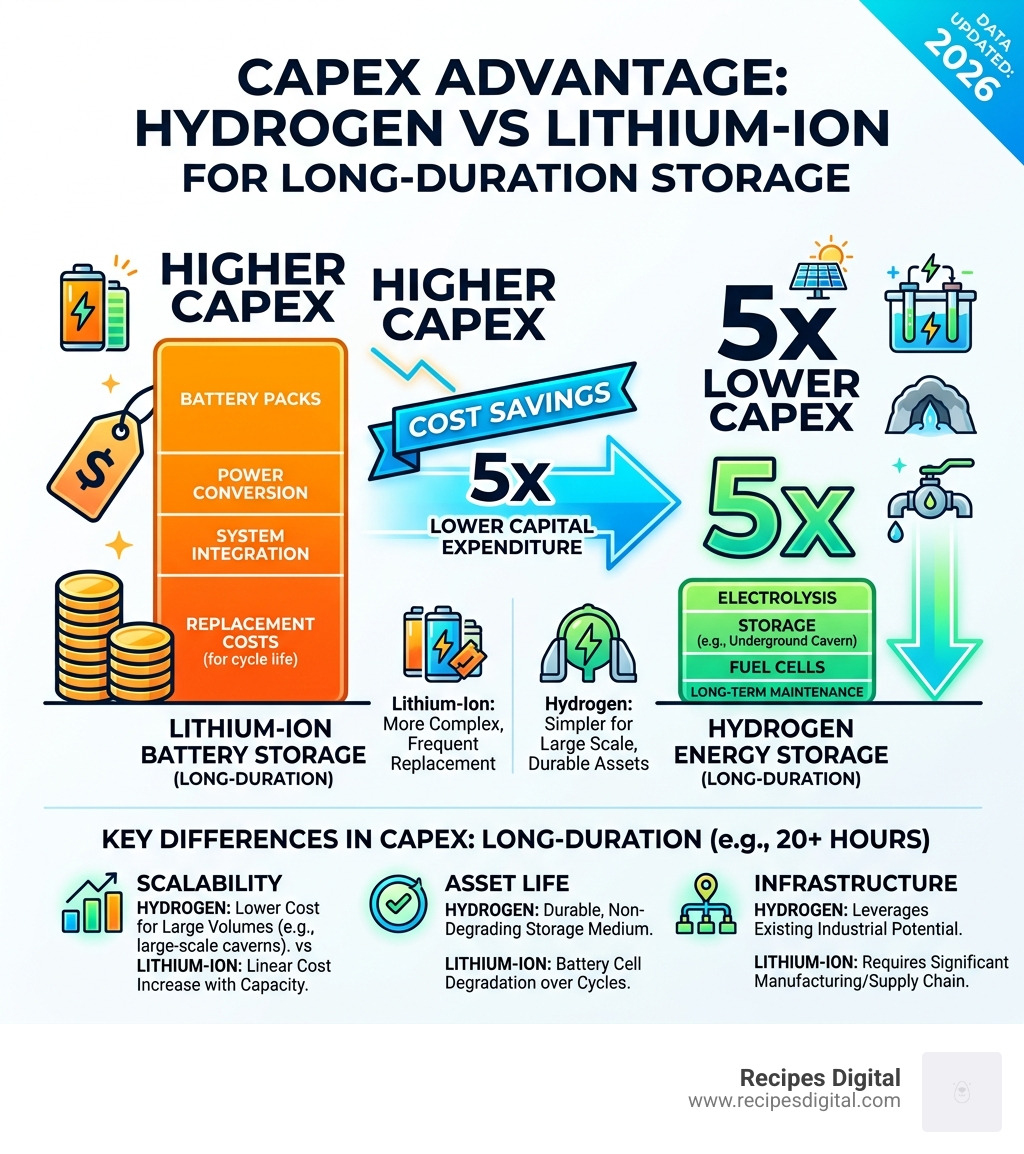
Currently, lithium-ion batteries are the kings of short-duration storage. They are incredibly efficient (85-95% round-trip efficiency). However, they have a major flaw: they are “power-heavy” but “energy-poor.” To store more energy in a lithium battery, you have to buy more expensive battery cells.
With hydrogen, if you want to store more energy, you just need a bigger tank. The marginal cost of adding another hour of storage is much, much lower. Research shows that hydrogen battery storage becomes more cost-effective than lithium-ion for any duration longer than 13 to 15 hours.
| Feature | Lithium-Ion Batteries | Hydrogen Storage |
|---|---|---|
| Best Use Case | Minutes to 4-8 hours | 12 hours to months (Seasonal) |
| Round-Trip Efficiency | 85% – 95% | 40% – 50% |
| Scaling Cost | High (must add more cells) | Low (must add more tank space) |
| Energy Density | Moderate | Very High |
| Resource Limits | Limited by Lithium/Cobalt | Abundant (Water/Salt Caverns) |
Capacity and Seasonal Balancing
The real “superpower” of hydrogen is its ability to handle the Dunkelflaute — a German word for periods when there is little sun and little wind. During these times, a grid relying only on short-term batteries would run dry in hours.
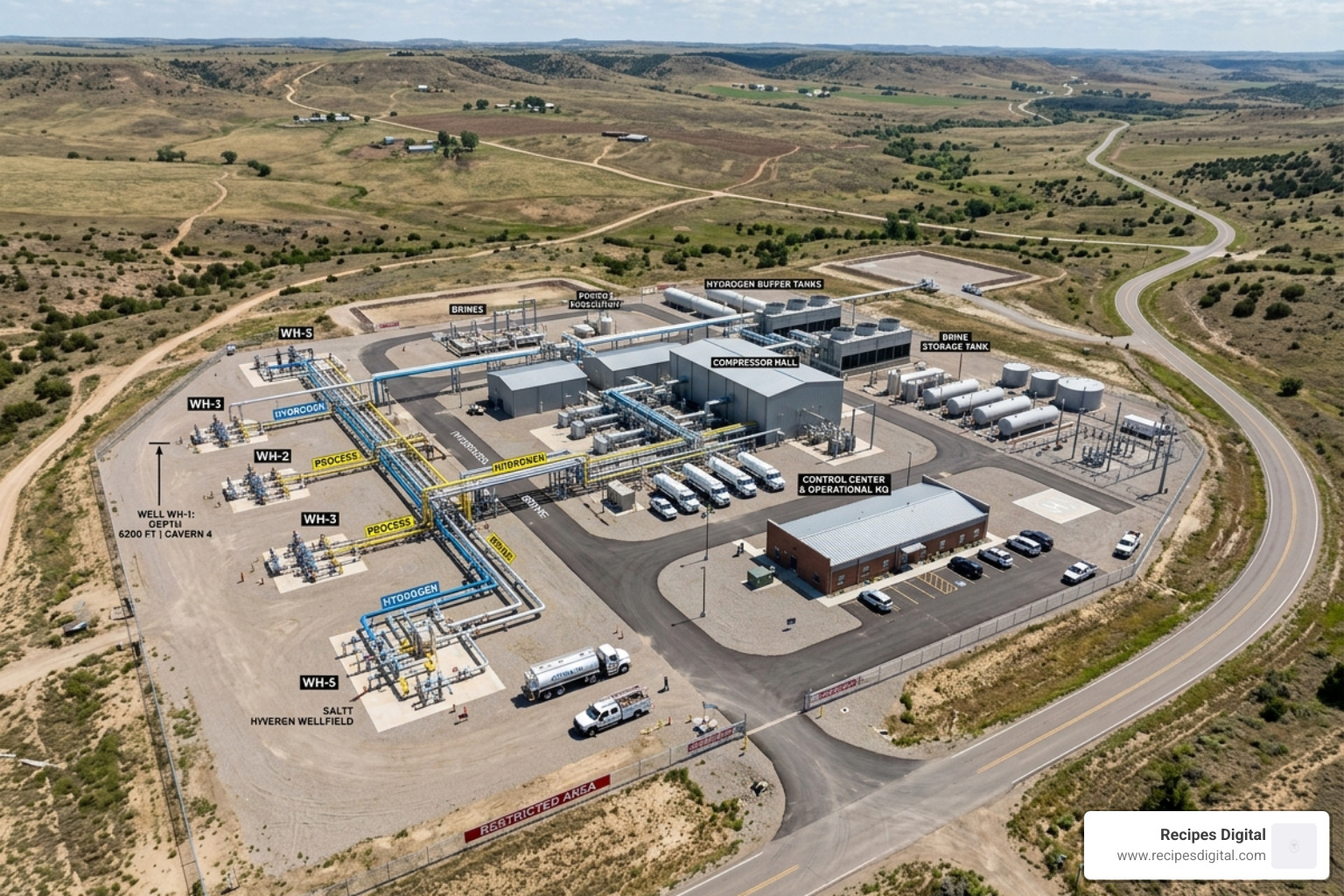
For a grid to reach 80-100% renewable penetration, we need massive reserves. California may need 30 TWh of storage, while Europe could require 200 TWh. Hydrogen can handle this scale. For example, a single salt cavern can hold 500,000 cubic meters of hydrogen at 2,900 psi, which is roughly 100 GWh of electricity. That is enough to power thousands of homes for an entire season. This is the strategic role of hydrogen in long-duration energy storage that will make 100% clean energy possible.
Cost Evolution and Learning Curves
Like solar panels and wind turbines before it, hydrogen technology is sliding down a “learning curve.” According to the StoreFAST model, costs are projected to drop significantly as we scale up production.
- PEM Electrolyzers: Currently around $740/kW, projected to drop to $250/kW.
- Fuel Cells: Currently ~$500/kW, projected to reach $250/kW.
- Storage Costs: Geological storage in salt caverns is already incredibly cheap at approximately $0.08/kWh for large capacities.
We are also seeing “revenue stacking.” A hydrogen plant doesn’t just store electricity; it can sell oxygen (a byproduct of electrolysis) or provide “ancillary services” to help stabilize grid frequency. This makes the financial case for hydrogen much stronger than a simple battery.
Methods for Storing Hydrogen Energy
Hydrogen is the lightest element in the universe, which makes it a bit of a “Houdini” — it loves to escape. To keep it contained, we use several different methods depending on how much we need and how long we plan to keep it.
Geological and Underground Storage
For massive, grid-scale storage, the earth itself provides the best containers.
- Salt Caverns: These are huge hollowed-out spaces in underground salt deposits. They are airtight, can handle high pressures (up to 2,900 psi), and don’t react with the hydrogen. They are the “gold standard” for storing hundreds of gigawatt-hours.
- Depleted Oil/Gas Fields: While more complex due to potential impurities, these existing structures offer enormous potential for repurposing fossil fuel infrastructure for green energy.
Advanced Solid-State and Chemical Storage
For smaller applications or places without salt caverns, we look toward chemistry.
- Metal Hydrides: Think of this like a sponge. Certain metals can “soak up” hydrogen atoms into their crystal structure and release them when heated. This is very safe and incredibly dense.
- Nickel-Hydrogen Batteries: These are a hybrid between a traditional battery and a fuel cell. Used in satellites for decades due to their 30-year lifespan, new research is looking at nickel-hydrogen batteries for large-scale energy storage by replacing expensive platinum catalysts with cheaper alloys.
- Liquid Organic Hydrogen Carriers (LOHCs): Hydrogen can be chemically bonded to a liquid (like a specialized oil), transported in standard oil tankers, and “unzipped” at its destination.
- Super Flow Batteries: Emerging research is even exploring “super flow” batteries using hydrogen peroxide, which could offer energy densities higher than current lithium-ion models.
The future of energy is converging as we find ways to blend battery chemistry with hydrogen’s incredible capacity.
Scaling Hydrogen Battery Storage for the Grid
We are already seeing real-world proof that this works. On Dachen Island in China, a demonstration project uses surplus wind power to produce 73,000 cubic meters of hydrogen annually. This system generates 100,000 kWh of electricity when the wind isn’t blowing, effectively creating a zero-carbon “co-generation” system.
In Australia, the Eco-Energy World project is planning a massive hub combining 300 MW of solar with 200 MW of electrolysis and 100 MW of battery storage. This “hybrid” approach is the future: batteries handle the quick spikes in demand, while hydrogen provides the deep, long-term reserves.
Efficiency and Performance Metrics
We have to be honest: hydrogen has an efficiency problem. While a lithium-ion battery returns about 90% of the energy you put into it, a standard hydrogen system (electrolysis + storage + fuel cell) usually has a round-trip efficiency of 40-50%.
Is that a dealbreaker? Not necessarily. When you have “curtailed” energy — solar or wind power that would otherwise be wasted because the grid can’t take it — a 40% return is infinitely better than 0%. Furthermore, by using the waste heat from electrolyzers to warm buildings, we can push the total system efficiency much higher.
Safety and Infrastructure Requirements
Safety is always a top priority for us at Recipes Digital. Hydrogen is non-toxic and, because it is so light, it disperses rapidly into the atmosphere if a leak occurs (unlike propane or gasoline, which pool on the ground).
However, hydrogen requires specialized infrastructure. It can make certain metals brittle and can leak through tiny gaps. Mitigation includes:
- Leakage Detection: Advanced sensors that can “smell” hydrogen long before it reaches dangerous levels.
- Pipeline Repurposing: Many existing natural gas pipelines can be retrofitted or “blended” to carry hydrogen.
- Permitting: Streamlined regulations are needed to help projects move from the “demo” phase to everyday reality.
Frequently Asked Questions about Hydrogen Storage
What is the round-trip efficiency of hydrogen storage?
Currently, most systems operate at a round-trip efficiency of 40% to 50%. This accounts for the energy lost during electrolysis, compression, and re-conversion in a fuel cell. While lower than batteries, this is expected to improve as high-temperature electrolyzers enter the market.
Is hydrogen storage safer than lithium-ion batteries?
Both have unique safety profiles. Lithium-ion batteries carry a risk of “thermal runaway” (fires that are hard to extinguish). Hydrogen is highly flammable but non-toxic and dissipates almost instantly if it leaks. With modern sensors and high-pressure tanks, hydrogen has a safety record comparable to natural gas.
Why is hydrogen better for long-duration storage?
Cost and scale. To store energy for a month using batteries, you would need millions of tons of lithium. To do it with hydrogen, you just need a large underground cavern or a set of steel tanks. Hydrogen is the only technology that can realistically provide “seasonal” storage to keep us powered through winter.
Conclusion
As we march toward a net-zero 2050, the “Lithium-Ion Conundrum” becomes clear: we simply don’t have enough minerals to build a global grid on short-term batteries alone. Hydrogen battery storage offers the missing piece of the puzzle. It allows us to capture the abundance of the summer sun and save it for the darkest winter nights.
At Recipes Digital, we are committed to providing you with the resources for sustainable, modern living. Whether it’s choosing the right solar setup for your home or understanding the massive shifts in our global energy grid, we’re here to help you navigate the transition. The grid of the future might just run on gas — the cleanest gas in the universe.
For more info about renewable energy resources, explore our latest guides and tips for a greener home.
