
Stop Buying and Start Building Your Own Solar Controller
Why Building a DIY Charge Controller Can Save Your Solar Setup
A diy charge controller is a device you build yourself to regulate the voltage and current flowing from your solar panels into your batteries — preventing overcharging, extending battery life, and keeping your off-grid system running safely.
Here’s a quick overview of what’s involved:
- Choose your type — PWM (simpler, cheaper) or MPPT (more efficient, better for larger systems)
- Gather core components — MOSFET, voltage regulator, comparator IC or microcontroller, resistors, diodes, and a heat sink
- Build and test — assemble on a breadboard first, then solder to a PCB
- Calibrate — set your high and low voltage thresholds for your specific battery (e.g., 14.4V full charge, 13.0V resume for a 12V lead-acid)
- Enclose and deploy — mount in a protective case and connect to your solar setup
Electricity bills are climbing. Grid reliability is shrinking. And solar power kits — while more affordable than ever — still come with one frustrating bottleneck: the charge controller.
Commercial units work fine, but you’re paying for features you may not need, and when they fail, they’re a black box. You can’t fix what you don’t understand.
The good news? A functional solar charge controller can be built with basic electronics skills, common components, and less than a weekend of your time. Whether you want a simple 555-timer circuit or a full Arduino-based MPPT build, the path is more accessible than most people think.
This guide walks you through everything — from understanding how charge controllers work, to building and calibrating your own.
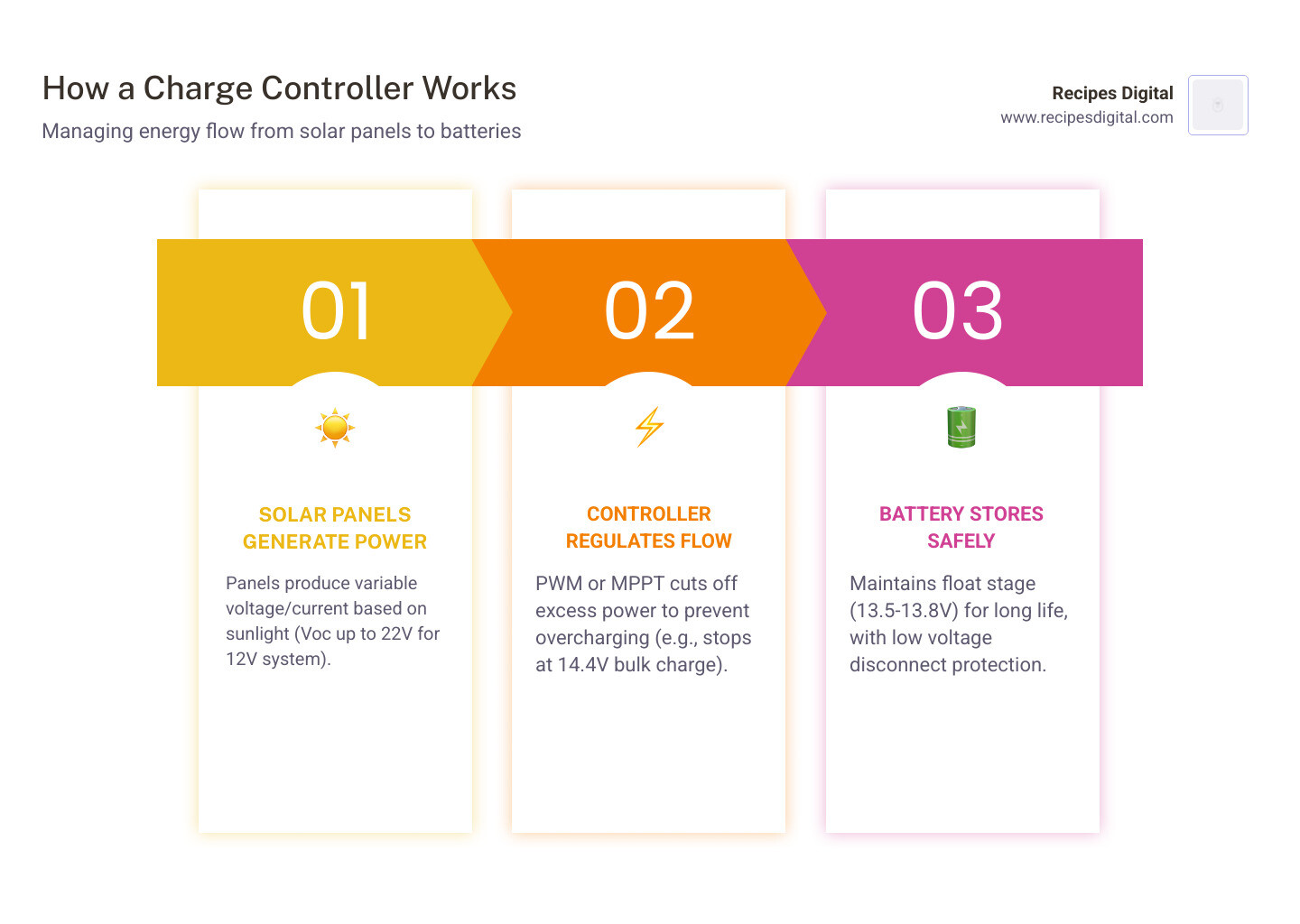
Understanding the Basics of a DIY Charge Controller
Before we heat up the soldering iron, we need to understand the “referee” of our solar system. A solar panel is a bit like an overenthusiastic friend pouring wine at a dinner party; without someone to say “stop,” they’ll keep pouring until the glass overflows and creates a mess. In solar, that “mess” is a fried battery.
The primary job of a diy charge controller is to manage the relationship between the PV generator (the panels) and the battery storage. As of April 2026, solar cells have become incredibly cost-competitive, but the batteries they charge—especially deep-cycle lead-acid and lithium varieties—remain a significant investment that requires protection.
PWM vs. MPPT: Which Should You Build?
There are two main technologies used to regulate solar power. Choosing the right one for your DIY project depends on your budget and your technical comfort level.
- Pulse Width Modulation (PWM): Think of this as a rapid “on-off” switch. When the battery is low, the switch stays on. As the battery nears its full charge, the switch flicks on and off faster and faster to maintain a steady voltage. It’s simple, reliable, and perfect for beginners.
- Maximum Power Point Tracking (MPPT): This is the high-tech version. MPPT controllers are essentially smart DC-to-DC converters. They take the high voltage from the panel and convert it down to the exact voltage the battery needs, increasing the amperage in the process. This can make your system 20% to 30% more efficient than a PWM setup.

| Feature | PWM Controller | MPPT Controller |
|---|---|---|
| Complexity | Low (Analog or Simple IC) | High (Microcontroller based) |
| Efficiency | 70% – 75% | 90% – 99% |
| Cost to Build | Very Low ($10 – $20) | Moderate ($30 – $60) |
| Best Use Case | Small systems, 12V panels | Large arrays, mixed voltages |
Interpreting Panel Specs: Voc, Isc, and Vmp
To build a controller, you must understand your panel’s “language.” A typical 100W solar panel might list a Voc (Open Circuit Voltage) of 24.3V and an Isc (Short Circuit Current) of 5.2A. However, real-world conditions (clouds, heat, and dust) often result in lower outputs, such as 21.8V Voc and 3.7A Isc. Your diy charge controller must be designed to handle the maximum theoretical values to ensure it doesn’t melt on a perfectly sunny day between 10:00 AM and 2:00 PM, when solar radiation peaks.
Essential Components and Circuit Design
Building a controller is a puzzle where every piece has a specific role. Here is the “grocery list” for a robust DIY build:
- Microcontroller (The Brains): For an advanced build, an Arduino Nano or ATTINY85 is popular. For a purely analog build, the classic 555 Timer IC is a legendary choice.
- MOSFET (The Muscle): We recommend an N-channel MOSFET like the IRF3205PBF. This acts as the high-speed switch that handles the actual power flow.
- Voltage Regulator: An LM317 or a low-dropout (LDO) regulator like the HT7533 ensures your internal electronics get a steady 3.3V or 5V, even when the solar panel is pushing 20V+.
- Blocking Diode: Essential for preventing “backflow.” Without this, your battery will actually try to power your solar panels at night, draining your hard-earned energy.
- Sensors: An ACS712 current sensor allows your microcontroller to see exactly how much power is moving.
- Heat Sink: Power components get hot. If you’re pushing more than 5A, a heat sink is non-negotiable to prevent component failure.
For those looking to go professional, you can design your circuit using software like EasyEDA and generate Gerber files to have a custom PCB manufactured for just a few dollars.
How to Assemble Your Custom Solar Regulator
Assembly is where the magic happens. We suggest starting on a breadboard—a solderless board that lets you plug components in and out. It’s much easier to fix a mistake here than after you’ve applied permanent solder.

Step-by-Step: Building a Basic PWM DIY Charge Controller
If you’re new to electronics, a PWM controller based on the 555 timer or an op-amp comparator is the best starting point.
- Set Up the Voltage Divider: Use resistors to “scale down” the battery voltage so your IC can read it safely.
- The Comparator Logic: Use an op-amp (like the LM358) to compare the battery voltage against a reference voltage (usually set by a Zener diode).
- The Switching Stage: Connect the output of your comparator to the gate of your MOSFET. When the battery hits 14.4V, the MOSFET should turn off (or begin pulsing).
- Add Protection: Place a fuse on the battery line and a blocking diode on the solar input.
For detailed schematics, we highly recommend checking out these community favorites:
Advanced Build: Creating an MPPT DIY Charge Controller
An MPPT controller is more complex because it uses a Buck Converter circuit. This involves an inductor and a capacitor to “step down” voltage while “stepping up” current.
- Code the Algorithm: Most DIY MPPTs use the Perturb and Observe (P&O) algorithm. The Arduino slightly changes the voltage and “observes” if the power output goes up or down, constantly hunting for the “Maximum Power Point.”
- Synchronous Rectification: For high efficiency (up to 99%), use two MOSFETs instead of one MOSFET and a diode. This reduces heat and power loss.
- Monitoring: Add a 16×2 LCD display to show real-time stats like panel voltage, battery state of charge, and charging Amps.
- Auto-Detection: Program your Arduino to detect if you’ve connected a 12V or 24V battery and adjust its charging profile automatically.
You can find a fantastic open-source implementation here: DIY Solar Charge Controller – Hackster.io.
Safety, Calibration, and Troubleshooting
Working with electricity requires respect. Even a small 100W panel can produce a spark that causes a fire if short-circuited.
Safety Precautions
- Connect the Battery First: Always connect the battery to the controller before the solar panels. This ensures the controller has a stable power source to run its logic before the high-voltage panel power arrives.
- Use Proper Wire Gauge: For a 10A system, use at least 12 AWG wire. Thin wires will heat up and drop voltage, wasting energy.
- Fuse Everything: Place a fuse as close to the battery positive terminal as possible.
Calibration
Use a multimeter to calibrate your trimpots (adjustable resistors). For a 12V lead-acid battery, you typically want:
- Bulk/Absorption: 14.4V (The “full” target)
- Float: 13.8V (The “maintenance” level)
- Low Voltage Disconnect: 11.5V (To prevent over-discharging)
Troubleshooting Common Issues
- Overheating: If your MOSFET is too hot to touch, you need a larger heat sink or better ventilation in your enclosure.
- Battery Not Charging: Check your blocking diode. If it’s installed backward, no power will flow. Also, ensure your solar panel Voc is at least 2V higher than your battery voltage.
- Reverse Polarity: If you accidentally swap plus and minus, you can fry your microcontroller instantly. Always double-check with a multimeter before plugging in.
Frequently Asked Questions about Solar Controllers
Is it cheaper to build or buy a solar charge controller?
For a basic 10A PWM controller, commercial units are often cheaper due to mass production. However, for a high-quality 60A MPPT controller, building your own can save you over $100. More importantly, the “repairability” of a DIY unit is priceless—you can fix it for pennies if a component fails.
Can I use a DIY controller for lithium (LiFePO4) batteries?
Yes, but you must be careful. Lithium batteries are less forgiving than lead-acid. You must ensure your diy charge controller does not have a “desulfation” or “equalization” mode, as the high voltage (15V+) can trigger the battery’s internal BMS to shut down or damage the cells. Stick to a strict 14.4V or 14.6V cutoff.
What is the most common mistake when building a DIY controller?
The “Bone-head” mistake, as many hobbyists call it, is forgetting the common ground or failing to use a heat sink. Another frequent error is using a standard linear regulator (like an LM7805) without realizing how much heat it will generate when dropping 20V down to 5V. Always calculate your power dissipation!
Conclusion
Building your own solar hardware is the ultimate step toward true energy independence. By moving away from “black box” commercial units, you gain the skills to maintain, repair, and optimize your power system for decades to come.
At Recipes Digital, we believe that sustainable modern living starts with understanding the tools we use. Whether you are looking for digital resources on solar batteries, panel mounting, or energy-saving tips, we are here to help you navigate the renewable energy landscape.
Ready to take the next step in your green energy journey? More info about sustainable energy solutions can be found on our main hub, where we share the latest in modern energy-saving technology. Stop buying, start building, and take control of your power today!
