
Why Two Inputs Are Better Than One for Your MPPT Controller
Understanding the Dual Input MPPT Charge Controller
A dual input mppt charge controller is a device that charges your batteries from two power sources at once — typically solar panels and a vehicle alternator — while using Maximum Power Point Tracking to squeeze every watt possible out of your solar array.
Here’s what you need to know at a glance:
| Feature | What It Means for You |
|---|---|
| Two power inputs | Charge from solar and alternator simultaneously |
| MPPT technology | Up to 10–30% more energy than older PWM controllers |
| Dual battery output | Charge house and starter batteries from one unit |
| Battery compatibility | Works with LiFePO4, AGM, Gel, Sealed, and Flooded batteries |
| Best for | RVs, campervans, boats, and off-grid mobile setups |
If your solar panels are your only power source, a standard single-input MPPT controller may be all you need. But if you’re living or traveling off-grid — in an RV, a van, or on a boat — you often have two sources of power available: the sun and your running engine. That’s where a dual input controller earns its place.
Standard MPPT controllers ignore your alternator entirely. A dual input model uses both, so your batteries charge faster and more reliably whether you’re parked in the sun or driving down a highway on a cloudy day.
The result? Less time worrying about dead batteries. More time actually living off-grid.
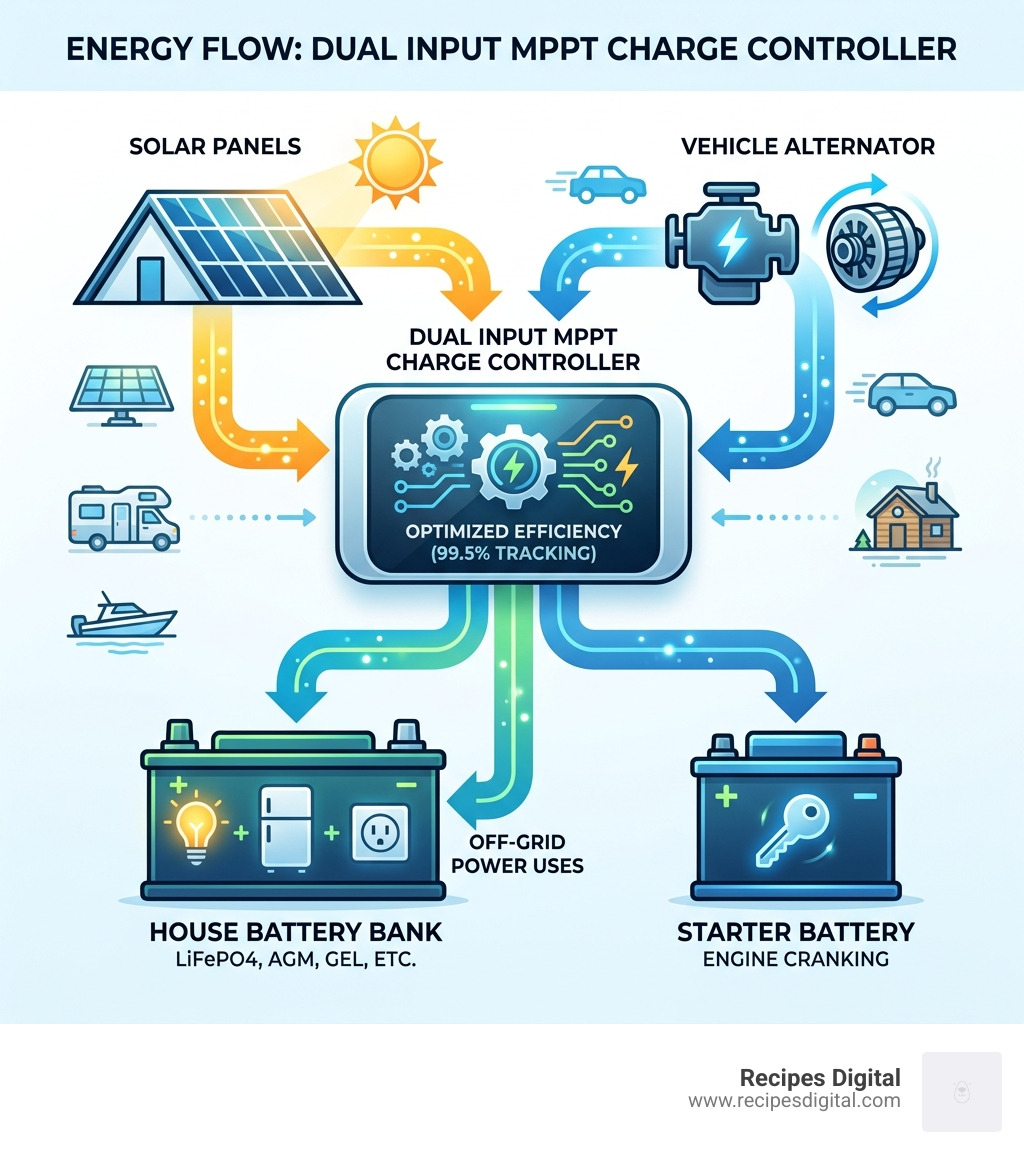
As we move deeper into 2026, the technology behind these controllers has become more efficient than ever. Most high-quality models now boast a tracking efficiency of no less than 99.5%. This means the controller is incredibly fast at finding the “Maximum Power Point” of your solar panels, even when clouds are racing across the sky or you’re driving through a forest with dappled shade.
How a Dual Input MPPT Charge Controller Handles Multiple Battery Banks
One of the most common headaches in the RV and marine world is managing two different battery systems: the “house” (or service) battery that runs your lights and fridge, and the “starter” battery that cranks your engine.
In the past, you needed a complex web of isolators and separate chargers to keep both healthy. A dual input mppt charge controller simplifies this by acting as the brain of your entire electrical system. It prioritizes your house battery (BATT1) to ensure your living space has power, but it doesn’t forget about your starter battery (BATT2).
Many models, such as the DuoRacer 10~30A Dual Battery MPPT Charge Controller | EPEVER, offer a dedicated trickle charge for the starter battery. This is usually a lower current, around 1A, which is just enough to keep the starter battery topped up and ready to go, preventing that sinking feeling of a dead engine after a week of camping.
The controller often utilizes a built-in Voltage Sensitive Relay (VSR). This ensures that the two battery banks remain isolated when they aren’t being charged, so you don’t accidentally drain your starter battery while watching a movie in your van at night.
Distinguishing Dual PV Inputs from Dual Battery Outputs
It’s easy to get confused by the terminology, so let’s clear up a common mix-up. There are actually two different types of “dual” controllers on the market:
- Dual PV Input Controllers: These have two separate sets of inputs for solar panels. This is brilliant if you have panels on different parts of your roof (one facing East, one facing West) because the controller has two independent MPPT trackers. One array can be in the shade while the other works at full capacity.
- Dual Battery Output Controllers: These take one or more power sources (Solar + Alternator) and split the output to charge two different battery banks.
For most of us at Recipes Digital, when we talk about a dual input mppt charge controller, we are referring to the “Hybrid” style that accepts both solar and alternator power to charge your batteries. However, if you have a massive off-grid setup with multiple solar arrays, you might look at something like the TES Series (60~100A) Dual PV Input MPPT Charge Controller – EPEVER, which is designed for high-power management of independent solar arrays.
Key Benefits of Dual Input Charging for Solar Systems
Why should you choose a dual input model over a standard one? The benefits come down to efficiency, space, and peace of mind.
| Feature | Single-Input MPPT | Dual Input MPPT (Solar + DC-DC) |
|---|---|---|
| Power Sources | Solar Only | Solar + Alternator |
| Charging Speed | Dependent on Sun | High (even while driving at night) |
| System Complexity | Requires separate DC-DC charger | All-in-one design |
| Battery Protection | Basic | Advanced (Starter & House) |
| Tracking Efficiency | ~99% | 99.5% + |
One of the biggest wins is the efficiency boost. Traditional PWM (Pulse Width Modulation) controllers are like a simple on/off switch. MPPT technology is more like a smart transmission in a car—it constantly adjusts to find the best “gear” for the current conditions. This can increase your charging efficiency by 10% to 30% compared to PWM.
Furthermore, these units are space-savers. In a van or a small boat, every square inch counts. Instead of mounting a solar controller and a separate DC-DC battery-to-battery charger, a dual input unit combines them into one box. This doesn’t just save space; it significantly reduces the amount of heavy-gauge wiring you have to run, which saves weight and money.
Sizing Your Dual Input MPPT Charge Controller for Off-Grid Use
Sizing is where many DIYers get stuck. You need to look at three main numbers: Maximum PV Input Power, Maximum Voltage, and Maximum Charging Current.
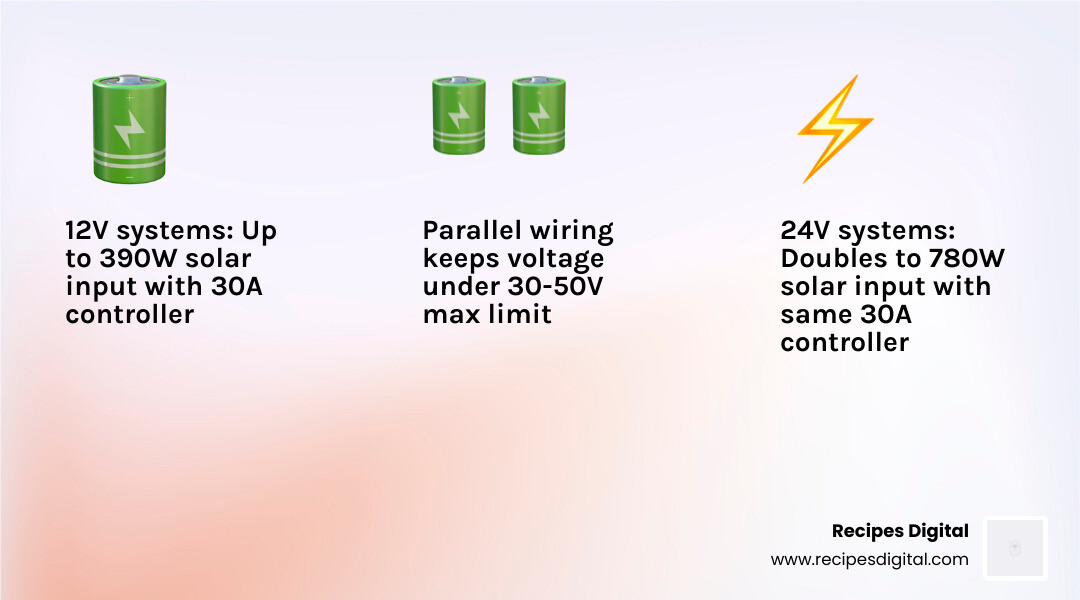
- 12V vs. 24V Systems: Most dual input controllers are designed for 12V systems (common in vans), but some high-end models can handle 24V systems. For example, a 30A controller might support up to 390W of solar on a 12V system, but that same controller could handle up to 780W on a 24V system.
- Voltage Limits: Pay close attention to the Maximum Solar Input Voltage. Many compact dual input units have a limit of 30V or 50V. This means you usually cannot wire your solar panels in a long “series” string (which increases voltage); you’ll likely need to wire them in “parallel” to keep the voltage within the controller’s safety range.
- Current (Amps): A 30A controller like the 30A MPPT Dual-Battery Controller | ZHCSolar is usually perfect for small to mid-sized vans with 200W-400W of solar. If you have a massive motorhome with 800W+ of solar, you’ll want to step up to a 50A or 60A model.
Technical Specifications and Battery Compatibility
In 2026, the standard for a high-quality dual input mppt charge controller is a conversion efficiency of around 98.5%. This means very little energy is lost as heat during the process of changing the high-voltage solar power into the specific voltage your battery needs.
Most modern controllers use “adaptive three-stage charging”:
- Bulk: Fast charging until the battery reaches about 80%.
- Absorption: Slowing down to top off the battery safely.
- Float: A tiny “trickle” to keep the battery at 100% without overcharging.
Temperature compensation is another critical spec. Batteries are chemically sensitive; they need higher voltages when it’s freezing and lower voltages when it’s scorching hot. A good controller will have a temperature sensor (either internal or a remote probe) to adjust these settings automatically.
Supported Battery Chemistries in 2026
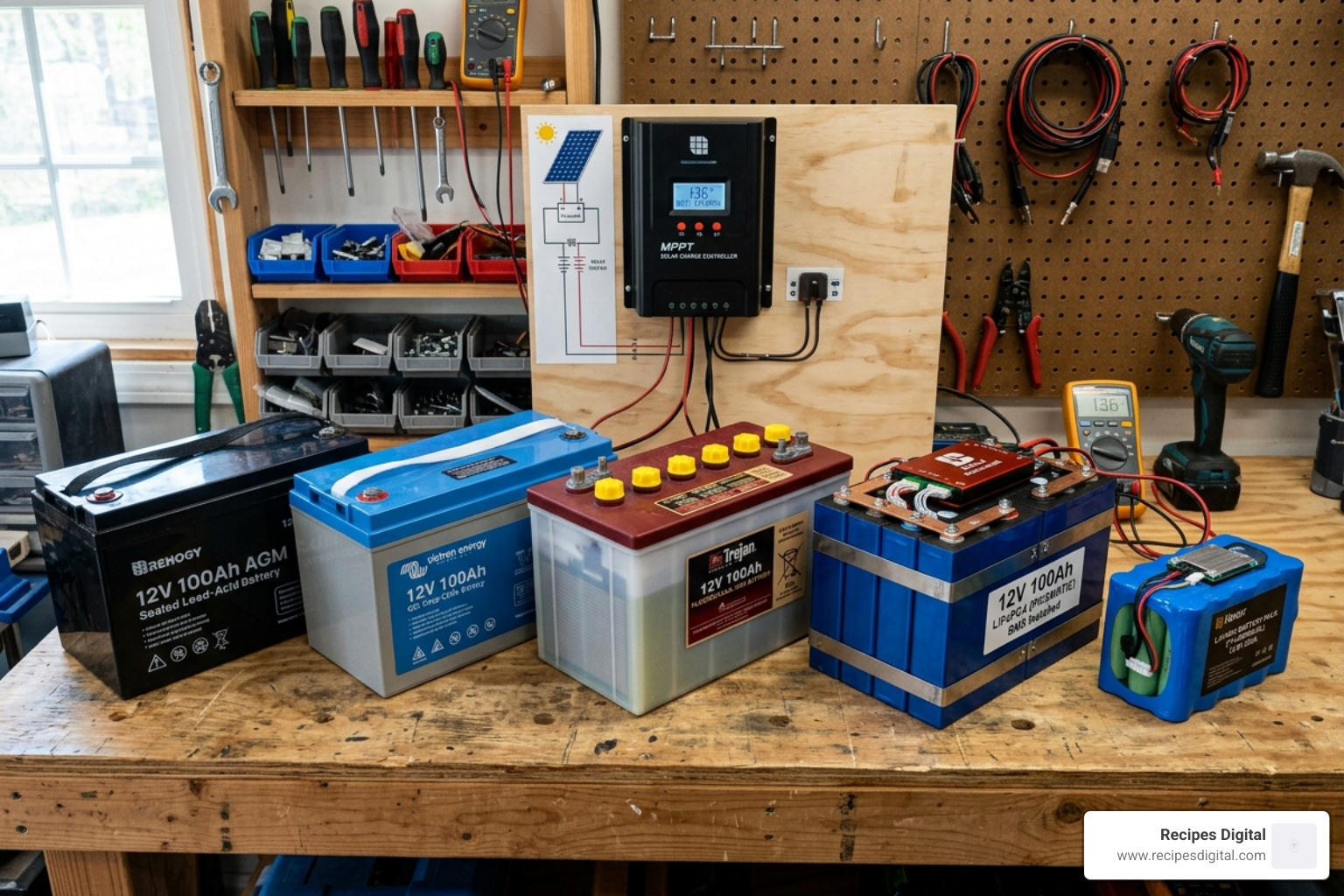
We’ve come a long way from the days of only using heavy lead-acid batteries. Today’s dual input controllers are incredibly versatile. Many models can support up to five different battery types:
- LiFePO4 (Lithium Iron Phosphate): The gold standard for modern off-grid living. They are light, can be drained deeply, and last for thousands of cycles.
- Lithium-ion (NCM): Often used in portable power stations.
- AGM (Absorbed Glass Mat): A popular, maintenance-free lead-acid variant.
- Gel: Great for deep-cycle applications.
- Flooded: The traditional “wet” lead-acid battery.
When selecting your controller, ensure it has a specific “Lithium” or “User-defined” profile. Lithium batteries are picky—they don’t like the “equalization” mode used for lead-acid batteries, which can actually damage them. Controllers like the SRNE MD Dual-Battery MPPT Controller|12V|30/50A|55V provide 360-degree security to ensure your expensive lithium investment is never overcharged.
Installation and Safety Considerations
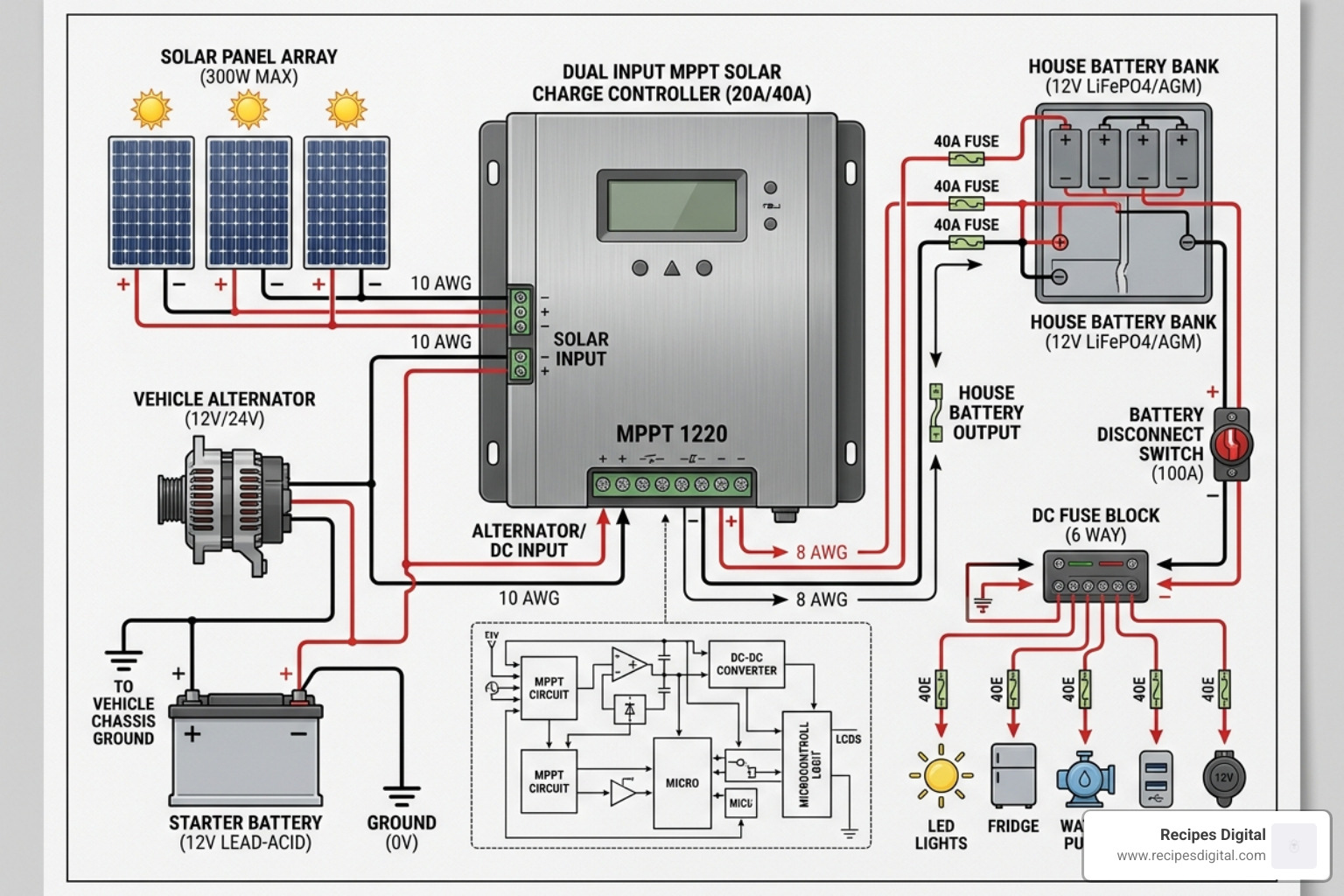
Installing a dual input mppt charge controller is slightly more involved than a standard solar controller because you are tapping into your vehicle’s engine electrical system.
One feature we love is the NEG-terminal design. This integrates the negative terminals for the solar, starter, and house batteries into one block, which makes for a much cleaner and easier installation.
Smart Alternators and the IGN Signal
If your vehicle was built after 2015, it likely has a “smart alternator” (Euro 6 standard). These alternators are designed to save fuel by turning off or lowering their voltage once the starter battery is full.
For a dual input charger to work with these, you must connect an IGN (Ignition) signal wire. This tells the charger, “Hey, the engine is actually running, even if the voltage looks low!” This allows the charger to pull power from the alternator to charge your house batteries even when the smart alternator is trying to take a nap.
Safety First: Protections You Need
Don’t settle for a bargain-bin controller that skimps on safety. A high-quality unit should include:
- Reverse Current Protection: Prevents your batteries from draining back into your solar panels at night.
- Soft Start Circuit: Gradually increases the power when you turn things on to prevent sparks or blown fuses.
- Over-temperature Protection: The unit should throttle back its power if it gets too hot (usually above 65°C or 149°F).
- PV Short Circuit Protection: Safeguards the unit if a wire gets pinched or damaged.
Monitoring and Smart Features
In 2026, we shouldn’t have to crawl into a dark cupboard with a flashlight just to check our battery levels. Most modern controllers now offer:
- Bluetooth Connectivity: Use an app on your smartphone to see real-time energy stats, historical data, and change battery settings.
- RS485/Modbus: For those who like a dedicated screen, these ports allow you to plug in a remote display (like the EPEVER MT11) or integrate the data into a larger system monitoring hub.
- Low Power Mode: Some units, like the EPEVER DuoRacer MPPT Dual Battery Solar Charge Controller, feature a “low self-consumption” mode. If the sun goes down and there’s no activity, the controller draws as little as 3mA to 4mA, ensuring it doesn’t become a parasite on your batteries.
Frequently Asked Questions about Dual Input Charging
Can I charge lithium and lead-acid batteries simultaneously?
Yes, but there’s a catch! Most dual input controllers allow your Primary (House) battery to be Lithium (LiFePO4), while the Secondary (Starter) battery is a standard Lead-Acid or AGM.
However, they usually require both batteries to have the same “nominal voltage.” This means you can’t have a 24V house battery and a 12V starter battery on the same small dual input controller. Both must be 12V or both must be 24V.
Do dual input controllers work with smart alternators?
Absolutely. As mentioned earlier, as long as the controller has an ignition sensing port (often labeled IGN or D+), it can handle the fluctuating voltages of modern Euro 6 alternators. This is one of the primary reasons to choose a dual input mppt charge controller over a simple solar-only model.
What is the difference between a DC-DC charger with MPPT and a pure solar MPPT?
Think of a “pure” solar MPPT as a specialist—it does one job (solar) very well. A DC-DC charger with MPPT (a dual input controller) is a multi-tasker.
While a pure solar MPPT might have a slightly higher solar-to-battery efficiency (99% vs 94-97%), the dual input model is far more practical for mobile life. It stabilizes the “noisy” and unstable voltage coming from your alternator, ensuring your expensive house batteries get a clean, steady charge while you drive.
Conclusion
The shift toward a dual input mppt charge controller represents a smarter way to manage off-grid energy. By combining the power of the sun with the reliability of your vehicle’s engine, you create a redundant system that keeps your “modern living” powered up, no matter where the road takes you.
At Recipes Digital, we believe that sustainable energy doesn’t have to be complicated. Whether you are building a weekend camper or a full-time off-grid home, choosing the right components is the first step toward energy independence.
Ready to dive deeper into sustainable power? Visit Recipes Digital for more energy-saving tips and digital resources to help you master your modern energy setup.
