
Why Your 12V Off Grid System Needs More Than Just Good Vibes
Why a 12V Off-Grid Solar System Is the Smartest First Step Toward Energy Independence
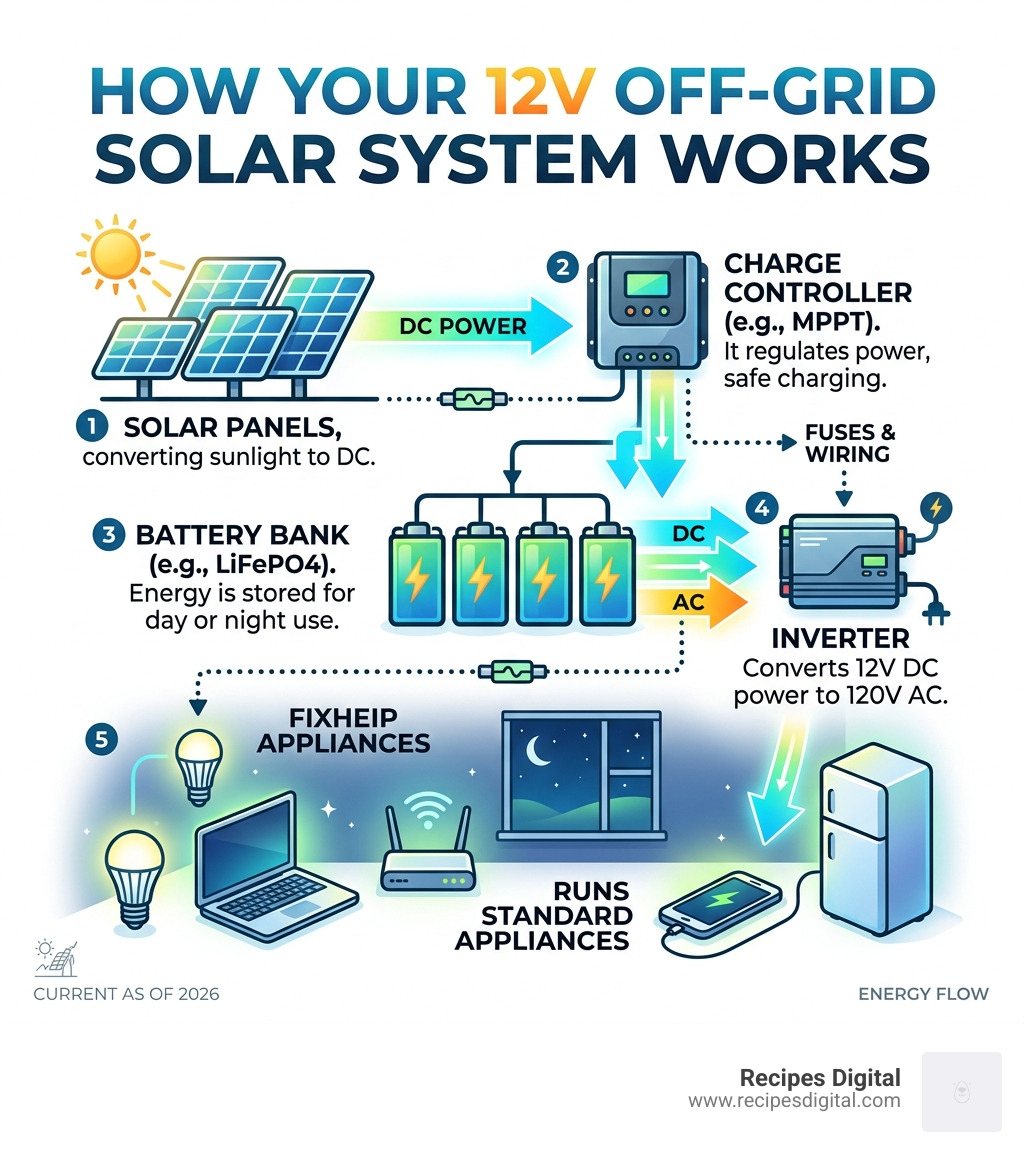
A 12v off grid solar system is a self-contained power setup that captures sunlight through solar panels, stores energy in a battery bank, and delivers usable electricity — all without connecting to the utility grid.
Here’s the quick version of how it works:
- Solar panels convert sunlight into DC electricity
- A charge controller (usually MPPT) regulates that power and safely charges your battery
- A battery bank (typically LiFePO4 or AGM) stores the energy for use day or night
- An inverter converts 12V DC power to 120V AC so you can run standard appliances
- Cables, fuses, and connectors tie everything together safely
A well-sized 400W system can produce around 1.6 kWh per day — enough to run LED lights, a WiFi router, a laptop, and phone chargers without touching the grid.
This kind of system is popular for RVs, cabins, vans, boats, and tiny homes. And for good reason: it cuts electricity bills, keeps the lights on during outages, and gives you real independence from the utility company.
But here’s the thing — good intentions alone won’t keep your fridge cold overnight. A lot of first-time builders underestimate what goes into a system that actually works reliably. The wrong battery, an undersized charge controller, or a cheap inverter can turn an exciting project into a frustrating (and expensive) mess.
This guide walks you through every piece of the puzzle — from sizing your system to picking the right components — so you can build something that works the first time.
Anatomy of a Reliable 12v off grid solar system
When we look at a 12v off grid solar system in April 2026, we see a collection of parts that must work in perfect harmony. Think of it like a recipe: if you use high-quality ingredients but forget the salt (or in this case, the fuses), the whole thing falls apart.
The Panels: Catching the Rays
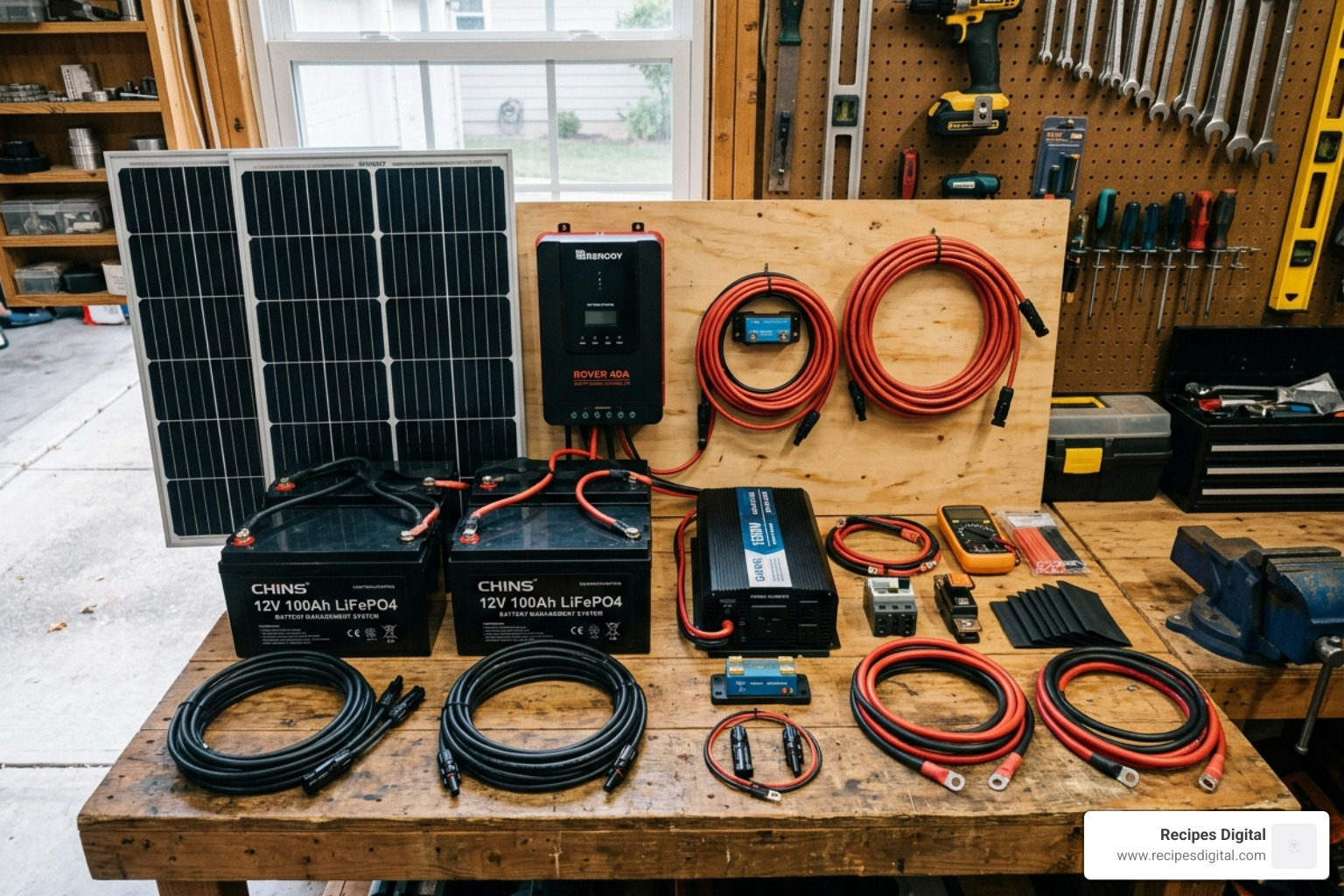
Most modern off-grid setups use monocrystalline cells. These are the “gold standard” because they offer the highest efficiency — often around 20.7% to 22%. Look for panels with sturdy aluminum frames and tempered glass (usually 3.2mm low iron glass). This ensures they can withstand 2400Pa wind loads and 5400Pa snow loads. High-end panels often feature N-Type technology for even better low-light performance and bypass diodes, which prevent one shaded cell from shutting down the entire panel’s output.
The Brain: MPPT Charge Controllers
We cannot stress this enough: your system needs a “brain” that knows how to handle energy. An MPPT (Maximum Power Point Tracking) controller is significantly better than the older PWM (Pulse Width Modulation) style. Research shows MPPT controllers are up to 40% more efficient, boasting tracking efficiencies of 99.5%. They ensure your battery gets the maximum possible charge even when the sun is playing hide-and-seek behind the clouds.
The Heart: The Battery Bank
The battery is where the magic is stored. While AGM and Gel batteries were the industry standard for decades, 2026 is the era of LiFePO4 (Lithium Iron Phosphate). These batteries are roughly half the weight of lead-acid alternatives and can last 8 to 10 times longer, offering over 3500 to 5000 cycles at 80-100% discharge rates.
The Muscle: Pure Sine Wave Inverters
If you want to run sensitive electronics like laptops, CPAP machines, or even a mini-fridge, you need a pure sine wave inverter. It converts the 12V DC from your battery into clean 120V AC power. A 1000W to 3000W inverter is typical for most 12V systems, allowing you to power everything from a coffee maker to a small TV.
The Connectors: Weatherproofing and Ease
Modern kits focus on “plug-and-play” simplicity. Using MC4 connectors and pre-drilled Z-brackets makes installation much easier for DIY enthusiasts. Weatherproofing is also key; ensure your panels are IP65 or IP67 rated to handle harsh environments, from coastal salt air to desert heat.
Sizing Your System: From Good Vibes to Real Watts
We’ve seen many people start their off-grid journey with “good vibes” and a single 100W panel, only to realize they can’t even keep their phone charged through a rainy weekend. Sizing a 12v off grid solar system requires a bit of math, but we promise it’s worth it.
Step 1: Calculate Your Load
Start by listing every device you plan to use. You need to find the Wattage of each device and multiply it by the hours you’ll use it per day.
- Laptop: 60 Watts x 3 hours = 180 Watt-hours (Wh)
- LED Lights: 10 Watts x 5 hours = 50 Wh
- Mini Fridge: 50 Watts (cycling) x 24 hours = ~600 Wh
- Total: 830 Wh per day.
Step 2: Account for the Safety Factor
Sunlight isn’t guaranteed. We always recommend a safety factor of 1.5 to 2.0. This accounts for cloudy days and “vampire” power draws. If you need 830 Wh, you should aim to generate at least 1,200 to 1,600 Wh per day.
Step 3: Daily Energy Yield Comparison
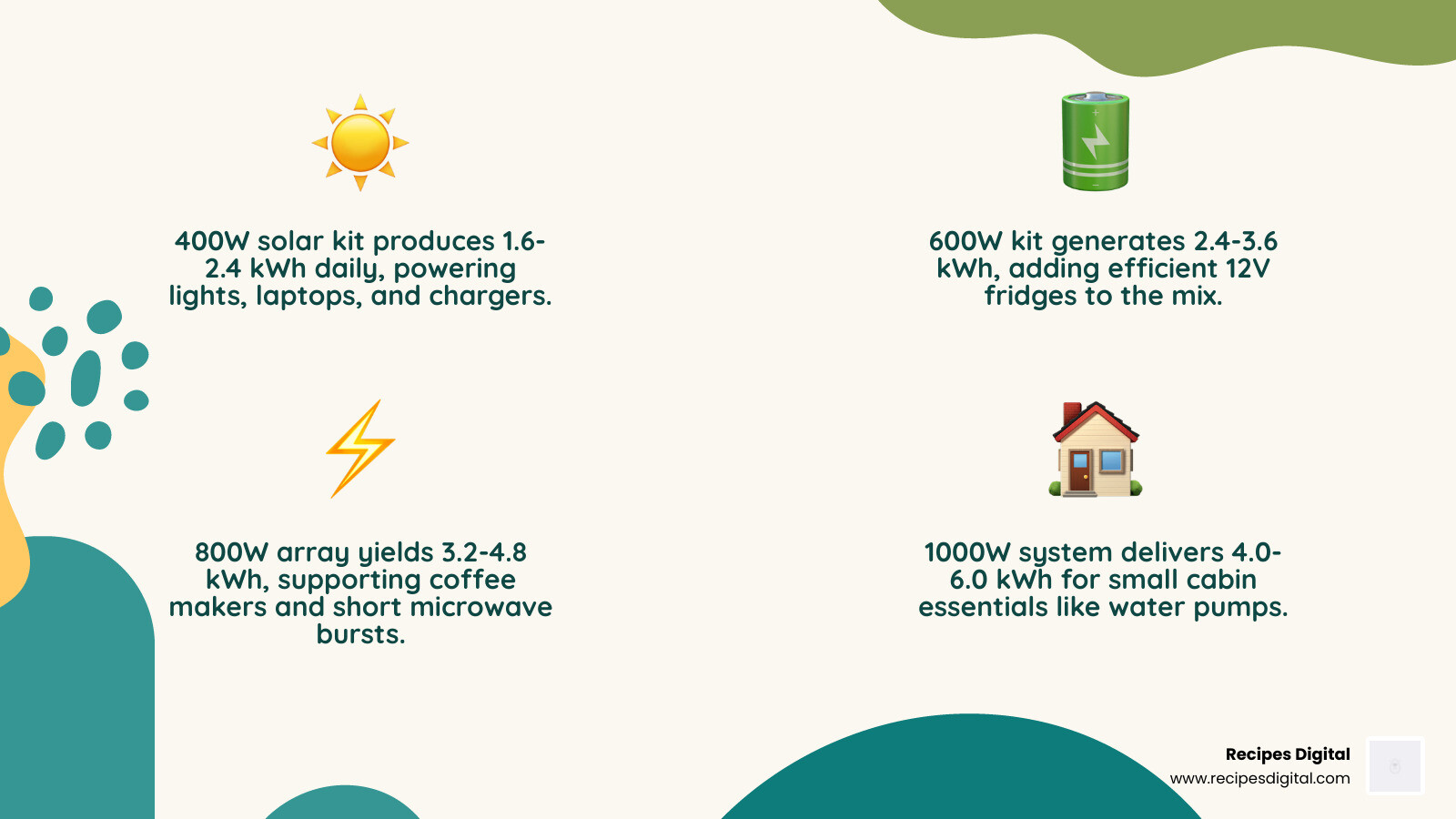
How much can popular kits actually produce? Here is a breakdown based on an average of 5 to 6 “peak sun hours” per day:
| Kit Size | Average Daily Production | What It Can Power |
|---|---|---|
| 400W Kit | 1.6 kWh – 2.4 kWh | Lights, laptop, router, phone chargers, small TV |
| 600W Kit | 2.4 kWh – 3.6 kWh | All of the above + a highly efficient 12V fridge |
| 800W Kit | 3.2 kWh – 4.8 kWh | Basics + coffee maker, microwave (short bursts) |
| 1000W Kit | 4.0 kWh – 6.0 kWh | Small cabin essentials, water pumps, multiple appliances |
Battery Capacity Considerations
For a 12V system, capacity is measured in Amp-hours (Ah).
- A 100Ah LiFePO4 battery gives you 1,280Wh of energy.
- A 200Ah battery bank gives you 2,560Wh. If your daily needs are 830Wh, a 100Ah lithium battery is perfect for one day of use, but a 200Ah bank gives you the “buffer” needed for a rainy day without sun.
Choosing the Heart: LiFePO4 vs. AGM Batteries
Choosing a battery is the most expensive decision you’ll make for your 12v off grid solar system. In 2026, the debate usually boils down to the tried-and-true AGM versus the high-performance LiFePO4.
The Case for LiFePO4 (Lithium)
Lithium is the clear winner for most mobile and full-time off-grid applications.
- Cycle Life: While an AGM battery might give you 500 cycles, a LiFePO4 battery like those from modern kits offers 3,500 to 5,000 cycles.
- Depth of Discharge (DOD): You can safely use 100% of a lithium battery’s capacity. With AGM, you should only use 50% to avoid damaging the cells. This means a 100Ah lithium battery actually provides twice the usable power of a 100Ah AGM.
- Weight: Lithium is about 60% lighter. A 100Ah lithium battery weighs roughly 27 lbs, compared to 60+ lbs for an AGM.
- Flat Voltage Curve: Lithium stays at a steady voltage (around 13V) until it’s nearly empty. This keeps your appliances running efficiently.
The Case for AGM (Lead-Acid)
AGM batteries still have a place, especially for backup systems that aren’t used daily.
- Cost: They are significantly cheaper upfront.
- Cold Weather: Standard lithium batteries cannot be charged below freezing (0°C) without damage. AGM batteries handle extreme cold better, though some premium lithium batteries now include “Internal Even-Heat Technology” to solve this.
For those looking for a high-powered, robust solution, we often point toward comprehensive kits like the Complete Off-Grid Solar System – 4,000 Watt 12VDC Inverter/Charger 120 – Emergency Energy Solution. This system uses 200Ah batteries to provide roughly 2.3kWh of usable energy, enough to power a refrigerator for 24+ hours or a CPAP machine for 80+ hours.

Maximizing Efficiency in a 12V Solar Array
Efficiency isn’t just about the panels; it’s about how the energy moves through your 12v off grid solar system. If you have 400W of panels but thin wires and a cheap controller, you might only see 200W at the battery.
MPPT vs. PWM: The Efficiency Gap
As we mentioned, MPPT is non-negotiable for serious users. An MPPT controller acts like an automatic transmission in a car, constantly adjusting the voltage and current to find the “sweet spot” (the Maximum Power Point). This allows for up to 99% tracking efficiency.
Anti-Shading Technology
Even a small amount of shade on one corner of a panel can drastically reduce output. High-quality monocrystalline panels use bypass diodes to allow current to flow around shaded cells. When mounting your panels, ensure they are clear of AC units, antennas, or roof racks that might cast shadows.
Wiring and Cable Gauge
Voltage drop is a major enemy of 12V systems. Because the voltage is low, resistance in the wires can eat up your power.
- Use 10 AWG solar extension cables for the panels.
- Use 4/0 AWG or 2 AWG battery cables for the connection between the battery and the inverter to handle high current surges.
- Ensure all connections use MC4 connectors for a water-tight, secure fit.
Monitoring Your System
In April 2026, you shouldn’t have to guess how your system is doing. Most modern charge controllers and batteries include Bluetooth modules. Using an app on your phone, you can see real-time data: how many watts are coming from the sun, the battery’s state of charge, and how much power your fridge is pulling.
Installation and Safety for 12V Off-Grid Living
Safety is where we move from “DIY enthusiast” to “responsible power plant owner.” A 12v off grid solar system can generate high amperage, which creates heat. If not managed, heat creates fire.
The Battery Management System (BMS)
If you choose LiFePO4, the BMS is your best friend. This internal circuit board protects the battery from:
- Overcharging: Cutting off power when the battery is full.
- Over-discharging: Preventing the battery from being drained to a point of no return.
- Short-circuits: Instantly shutting down to prevent fire.
- Temperature extremes: Stopping the charge if the battery is too cold or too hot.
Fuses and Circuit Breakers
Every positive wire in your system should have a fuse or breaker.
- An inline fuse (usually 15A to 30A) between the panels and the controller.
- A large ANL fuse (100A to 250A) between the battery and the inverter.
- Circuit breakers allow you to easily shut down the system for maintenance.
Grounding and Certifications
For safety, ensure your components are ETL or UL listed. This means they’ve been tested to rigorous safety standards. Grounding your system to the chassis (in an RV) or a grounding rod (at a cabin) protects against lightning strikes and electrical surges.
Professional vs. DIY
While many kits are “plug-and-play,” if you are integrating your system into a home with a transfer switch or running 240V well pumps, we highly recommend consulting a certified solar installer or master electrician.
Frequently Asked Questions about 12v off grid solar system
What can a 12v off grid solar system power?
A typical 12V system is incredibly versatile. With a 1000W to 3000W inverter, you can power:
- Kitchen: Mini-fridges, coffee makers, microwaves, and blenders.
- Entertainment: LCD TVs, stereo systems, and WiFi routers.
- Maintenance: DC brushless water pumps and LED lighting.
- Health/Work: Laptops, phone chargers, and CPAP machines. Note: High-heat appliances like space heaters or air conditioners usually require much larger systems (24V or 48V).
How do I expand my 12v off grid solar system?
One of the best features of these systems is scalability.
- Panels: You can add more panels in parallel (to keep voltage at 12V) or series-parallel, provided your charge controller can handle the increased amperage.
- Batteries: You can connect additional 12V batteries in parallel (positive to positive, negative to negative) to increase your Amp-hour capacity.
- Controller Limits: Always check your controller’s “Max PV Input Power.” For example, a 60A controller can typically handle up to 800W of solar at 12V.
Is a 12V system better than 24V for small cabins?
For small setups, 12V is often better because:
- Simplicity: Most RV and boat accessories (lights, fans, pumps) run directly on 12V DC, meaning you don’t need an inverter for everything.
- Availability: 12V components are the most common and easiest to find at any auto or marine store.
- Cost: For small loads (under 1000W), 12V is generally more cost-effective. However, if you plan to run a full-sized fridge or an AC unit, a 24V or 48V system is more efficient as it reduces the wire size needed and minimizes energy loss.
Conclusion
Building a 12v off grid solar system is one of the most rewarding projects you can undertake. It transforms the way you interact with the world, turning a remote cabin or a mobile van into a fully functional home. By moving beyond “good vibes” and focusing on high-quality components — like LiFePO4 batteries, MPPT controllers, and pure sine wave inverters — you ensure that your energy independence is reliable, safe, and long-lasting.
At Recipes Digital, we believe that sustainable living should be accessible to everyone. Whether you are looking for the perfect “recipe” for your van build or tips on maximizing your battery life, we are here to provide the digital resources you need for modern energy solutions.
Are you ready to stop worrying about the grid and start generating your own power? More info about solar energy solutions can help you take that next step toward a sustainable, off-grid lifestyle. The sun is providing the energy for free — you just need the right gear to catch it!
