
The Ultimate Guide to Choosing Your Next 12 Volt Inverter Kit
Why a 12 Volt Inverter Kit Is the Smartest First Step Toward Energy Independence
A 12 volt inverter kit is a complete package that converts 12V DC battery power into standard AC electricity — letting you run everyday appliances anywhere, from an RV to a boat to an off-grid cabin.
Here’s what you need to know at a glance:
| What you want to do | What to look for |
|---|---|
| Power sensitive electronics (laptops, CPAP) | Pure sine wave inverter |
| Run basic tools and lights | Modified sine wave inverter |
| Small mobile use (750W–1100W) | Entry-level kit with cables + fuses |
| Full off-grid or RV setup (3000W+) | Complete kit with battery, MPPT, and monitoring |
| Solar integration | Kit compatible with LiFePO4 + MPPT controller |
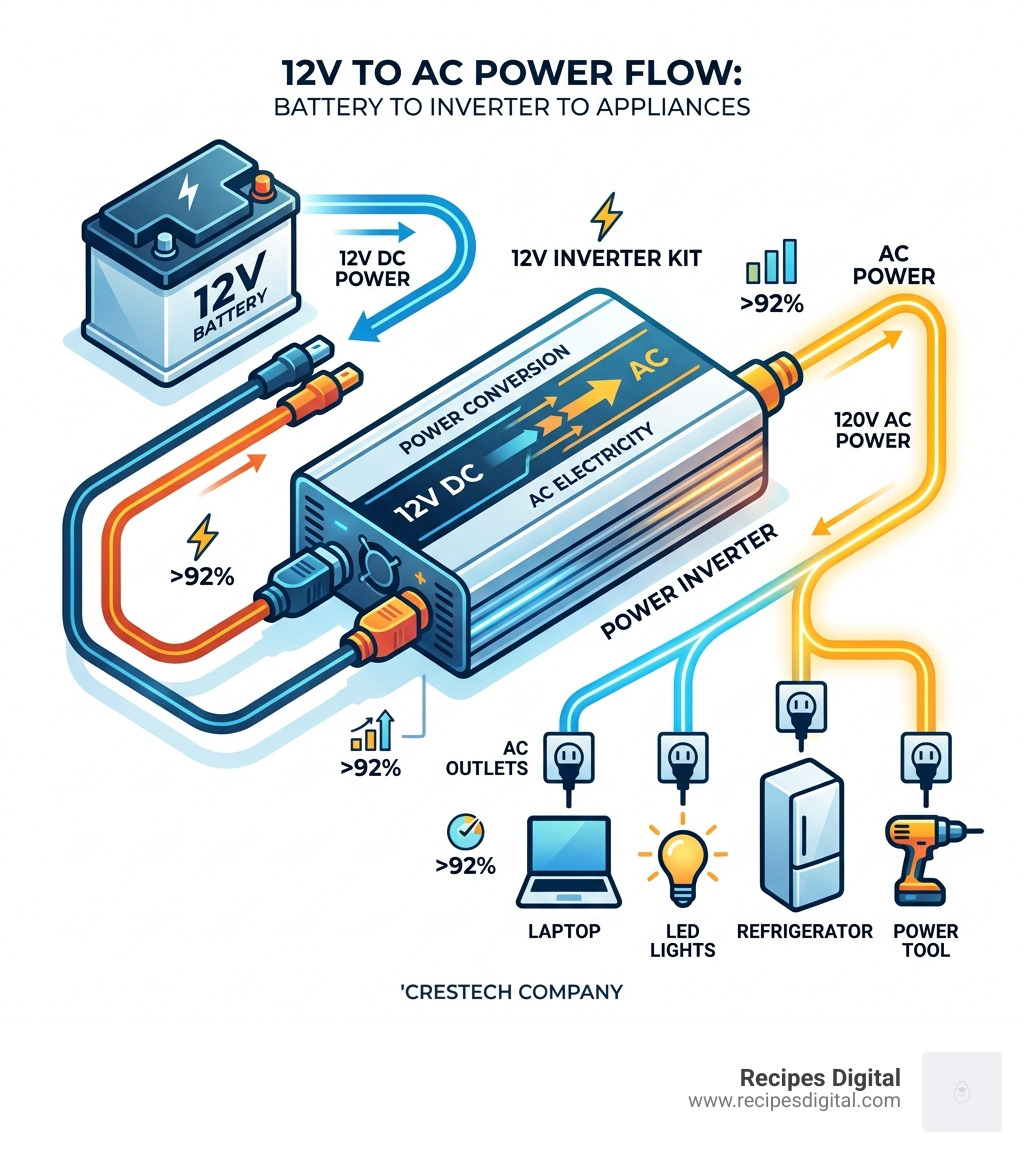
The core idea is simple. Your battery stores DC power. The inverter flips it into AC power — the same kind that comes out of a wall socket. A kit bundles the inverter with the wiring, fuses, and protection gear you need to do it safely.
Power ratings range from 750W for basic travel needs all the way up to 3000W+ for full-time off-grid living. Efficiency matters too — a well-designed 1000W unit can exceed 92% efficiency, meaning very little energy is wasted in the conversion process.
Whether you’re tired of high electricity bills, want a reliable backup during outages, or are building a mobile solar setup from scratch — the right 12V inverter kit is where that journey begins.
Understanding Core Components and Technology
When we dive into power conversion, we are essentially looking at how to take the “raw” energy stored in a battery and make it usable for the devices we use every day. A 12 volt inverter kit acts as the bridge between your DC (Direct Current) battery bank and your AC (Alternating Current) appliances.
In April 2026, the technology has reached a point where efficiency is the name of the game. For example, modern high-efficiency 1200W 12V power modules, such as those found in the InverterKit 1200W 12V , are 20% smaller than previous generations, making them much easier to mount in tight RV compartments or under van seats.
Pure Sine Wave vs. Modified Sine Wave
This is the most critical technical choice you will make. Think of the electricity coming out of your home wall outlet as a smooth, rolling wave. This is a Pure Sine Wave (PSW).
- Pure Sine Wave: These inverters produce a waveform with a Total Harmonic Distortion (THD) of less than 3%. For comparison, the standard utility grid usually sits around 5% THD. This “clean” power is essential for sensitive electronics like laptops, CPAP machines, and high-end audio equipment.
- Modified Sine Wave (MSW): These are more affordable but produce a “blocky” or “stair-step” waveform with a THD between 20% and 40%. While fine for simple tools or old-school incandescent lights, they can cause motors to run hot, create static on screens, and may even damage modern digital controllers.
If you are looking for a reliable middle-ground for automotive power, tools, and camping essentials, a unit like the Energizer 1100 Watt 12V to 110v Pure Sine Wave Inverter Dual AC Outlets & USB, Installation Kit Included, Automotive Power for Tools, Camping Essentials & Car Accessories – ETL Approved UL STD 458 – Walmart Business Supplies provides that clean 1100W continuous power while meeting strict ETL and UL 458 safety standards.
Essential Components of a Complete 12 Volt Inverter Kit
A true kit is more than just the “box” that does the converting. To install a system safely, we need several layers of protection and connectivity:
- Heavy-Duty Battery Cables: These must be thick enough to handle high amperage without melting.
- ANL Fuses and Holders: These protect your vehicle and battery from short circuits.
- OCPD (Over Current Protection Device): This is a fancy term for fuses or circuit breakers that open the circuit if the power flow gets dangerously high.
- Wired Remote and LCD Display: These allow you to monitor battery voltage and power consumption from the driver’s seat or a living area.
- Mounting Hardware: Proper brackets ensure the unit doesn’t vibrate loose on bumpy backroads.
For those with lighter needs, such as powering a small TV or charging a few gadgets, the Power Inverter 750 Watt, 12V is a great example of a compact kit. It features dual AC ports, USB outputs, and an LCD screen that shows you exactly how much of the 750W capacity you are using in real-time.
Sizing and Selecting Your 12 Volt Inverter Kit
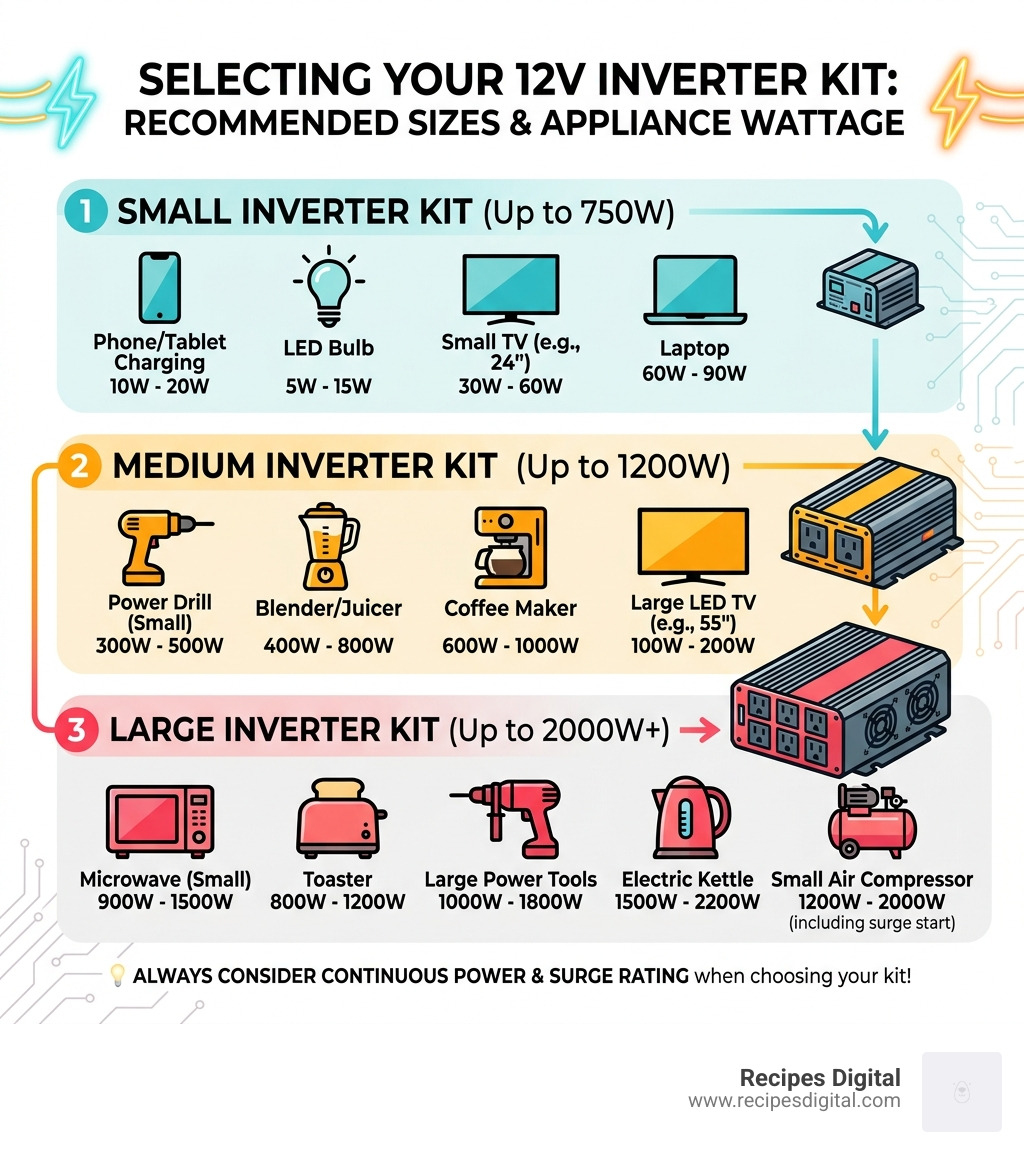
Choosing the right size is about more than just picking the biggest number. We have to balance our power needs with the capacity of our battery bank. If you buy a 3000W inverter but only have a small car battery, you’ll drain that battery in minutes (and likely damage it).
Matching Capacity to Your Application
When we calculate loads, we look at two numbers: Continuous Power and Surge Rating.
- Continuous Power: The amount of energy the inverter can output indefinitely.
- Surge Rating: A short burst of power (usually for a few seconds) to help motors or compressors start up. For instance, a fridge might only use 150W to run, but it needs 1200W for a split second to kick the compressor into gear.
| Application | Recommended Kit Size | Common Loads |
|---|---|---|
| E-Bike Accessories | 120W – 500W | LED lights, USB chargers, GPS |
| Solo Van Life | 1000W – 1200W | Laptop, small fan, LED lights, blender |
| Family RV / Boat | 2000W – 3000W | Microwave, coffee maker, hair dryer |
| Emergency Backup | 1100W – 2000W | Fridge, sump pump, phones, internet |
For a versatile mid-sized setup, we often recommend a 1000W 12V Pure Sine Wave Inverter | Renogy | Renogy US . This specific unit is a standout in April 2026 because it includes a UPS (Uninterrupted Power Supply) transfer switch. This means if you are plugged into a wall outlet (shore power) and the power goes out, the inverter automatically switches to battery power so fast your computer won’t even reboot. Plus, with built-in Bluetooth, you can check your power levels from your phone via an app.
Advanced Integration: Solar Panels and LiFePO4 Batteries
If you want to stay off the grid indefinitely, your 12 volt inverter kit needs some friends: solar panels and high-quality batteries.
We are seeing a massive shift toward LiFePO4 (Lithium Iron Phosphate) technology. Unlike old lead-acid batteries, lithium batteries can be drained almost completely without damage, they charge faster, and they last for 10 years or more. A high-end kit like the Renogy RV Solution provides 5.12kWh of energy — enough to run a small air conditioner or a large fridge for hours on end.
Maximizing Efficiency with Lithium Technology
When integrating with solar, we use an MPPT (Maximum Power Point Tracking) charge controller. These controllers are up to 30% more efficient than older PWM controllers. When you pair 600W of solar panels with a 3000W inverter, you create a self-sustaining ecosystem.
The Renogy RV Solution 5.12kWh Complete Off-Grid Solar Kit | 600W Panels & 3000W Inverter for RV & Van is a “power recipe” that includes everything:
- 600W Solar Panels: Featuring anti-shading technology.
- 3000W Pure Sine Wave Inverter: With a massive 6000W surge capacity.
- LiFePO4 Batteries: Equipped with self-heating for cold weather and an IP65 waterproof rating.
- Monitoring System: A central hub to see exactly how much sun you’re catching and how much energy you’re spending.
Installation and Safety Best Practices
Installing a 12 volt inverter kit is a rewarding DIY project, but electricity deserves respect. Here are our “Golden Rules” for a safe setup:
- Keep it Close: Mount the inverter as close to the battery as possible (usually within 3-5 feet). This prevents “voltage drop,” which is when energy is lost as heat inside the wires.
- Gauge Matters: If you are installing a 3000W inverter, you need massive 0000 AWG cables. Using thin wires is a fire hazard.
- Ventilation is Key: Inverters generate heat. Ensure there is at least 4-5 inches of clearance around the cooling fans.
- Fuse Everything: An ANL fuse should be placed on the positive cable as close to the battery as possible. This protects the wire itself from catching fire if there is a short.
- Grounding: Follow the manufacturer’s guide to ground the inverter chassis to your vehicle’s frame or a dedicated grounding rod.
Troubleshooting Your 12 Volt Inverter Kit
Even the best kits can have “hiccups.” If your inverter starts beeping or shuts down, don’t panic. Check these common culprits:
- Voltage Drop: If the inverter turns off as soon as you plug in a heavy load, your cables might be too thin or your battery might be too weak.
- Inductive Load Tripping: Motors (like in a vacuum or old fridge) require a huge surge. If your inverter isn’t sized for that “kick,” it will trip its safety breaker.
- Loose Connections: A loose nut on a battery terminal can cause high resistance, heat, and power failure. We recommend checking your connections every few months, especially in a vibrating RV.
Frequently Asked Questions about 12V Inverters
We get a lot of questions at Recipes Digital about how these systems perform in the real world. Here are the most common ones:
How long will a 12V inverter run on a 100Ah battery?
It depends entirely on the load! If you are running a 100W laptop, a 100Ah LiFePO4 battery (which has about 1200Wh of usable energy) could theoretically run it for about 10-12 hours. However, if you run a 1000W microwave, that same battery will be empty in about an hour.
Can I use a 12V inverter kit with my car’s alternator?
Yes, but be careful. Most standard car alternators are not designed to output high current for long periods while the car is idling. For small inverters (under 1000W), it’s usually fine while driving. For larger systems, we recommend a DC-to-DC charger to protect your alternator.
What is the difference between continuous and peak power?
Continuous power is what the inverter can handle all day long. Peak (or surge) power is a “burst” capacity meant to help appliances with motors start up. Always size your inverter based on the continuous wattage of all your devices combined.
Conclusion
Embracing a 12 volt inverter kit is about more than just having a place to plug in your toaster; it’s about the freedom to live, work, and explore on your own terms. Whether you are building a high-tech “digital nomad” van or simply want to keep your lights on during a storm, these kits provide the reliable, clean energy you need.
At Recipes Digital, we believe that modern living should be sustainable and efficient. By choosing the right components — from Pure Sine Wave inverters to LiFePO4 batteries — you are creating an energy recipe that will serve you for years to come.
Ready to start your journey into renewable energy? Explore our other digital resources for more energy-saving tips and solar accessories.
