
The Only Solar Battery Charging Calculator You Will Ever Need
Why Getting Your Solar Battery Charge Time Right Matters
A solar battery charging calculator takes the guesswork out of solar planning. Here is a quick answer to what most people need to know:
How to calculate solar battery charging time:
- Convert your battery capacity to watt-hours: Ah x Volts = Wh
- Apply your Depth of Discharge (DoD): Wh x DoD %
- Divide by your solar panel’s effective output (panel watts x ~80% real-world efficiency)
- Adjust for charge controller efficiency (MPPT ~95%, PWM ~75-80%)
- Divide the result by your daily peak sun hours
Quick example: A 12V 100Ah lead-acid battery at 50% DoD needs roughly 9 peak sun hours to fully recharge using a 100W panel with an MPPT controller.
Estimating how long your solar panels will take to charge a battery sounds simple. Divide capacity by power, done — right?
Not quite.
Real-world solar charging depends on a lot of moving parts: your battery chemistry, how depleted it is, your local sunlight hours, your charge controller type, and even the temperature outside. Miss one of these variables and your estimate can be off by hours — or even days.
That gap between the “textbook answer” and what actually happens in your backyard is exactly why so many DIY solar setups end up undersized, with batteries that never fully recover before sunset.
The good news? Once you understand the key inputs, the math is straightforward — and a reliable calculator makes it even faster.
How to Use a Solar Battery Charging Calculator
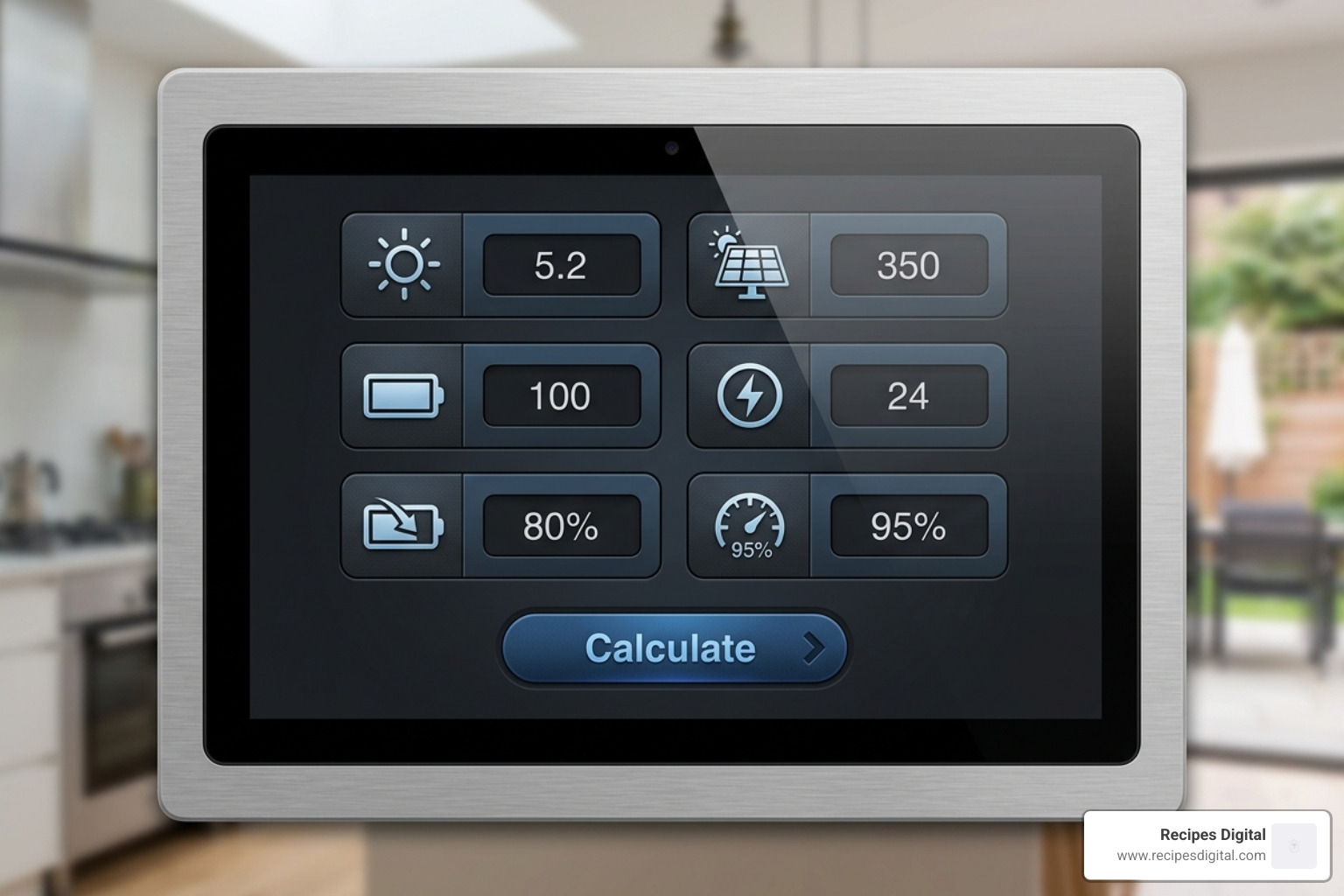
Using a solar battery charging calculator is the first step toward energy independence. Whether you are outfitting a campervan for a weekend getaway or designing a backup system for your home, these tools transform complex electrical physics into actionable data.
At its core, the calculator asks you to define your “bucket” (the battery) and your “faucet” (the solar panels). By inputting specific metrics like battery capacity in Amp-hours (Ah), system voltage (usually 12V, 24V, or 48V), and the total wattage of your solar array, the tool can simulate how quickly that bucket will fill up under various conditions.
For those looking to dive deeper into system design beyond just charging times, you can explore More info about solar services to see how these calculations fit into a broader energy recipe.
Step-by-Step: Using Your Solar Battery Charging Calculator
To get the most accurate result, you need to be precise with your inputs. Most modern calculators in April 2026 use the following workflow:
- Define Battery Capacity: Enter the Amp-hours (Ah) or Watt-hours (Wh) of your battery bank. If you have two 100Ah batteries in parallel, your input is 200Ah.
- Set Current State of Charge (SoC): How full is the battery right now? A battery at 20% charge requires significantly more time than one at 70%.
- Select Battery Type: This is crucial. A LiFePO4 battery has a different “charge acceptance” rate than a traditional lead-acid battery.
- Input Panel Wattage: Use the total rated wattage of your array (e.g., three 200W panels = 600W).
- Efficiency and Losses: Most calculators allow you to toggle between MPPT and PWM controllers. Always account for a 15-20% “real-world” loss for wiring and heat.
Why Every DIYer Needs a Solar Battery Charging Calculator
The primary reason to use a solar battery charging calculator is to prevent the “death by discharge” cycle. For lead-acid batteries, regularly discharging below 50% can slash their lifespan in half. For lithium batteries, while they are more resilient, you still want to ensure your panels can get them back to 100% before the sun goes down.
In April 2026, we are seeing a trend toward larger, more efficient LiFePO4 banks. Without a calculator, you might spend thousands on batteries only to realize your small solar array takes four days of perfect sun to charge them. A calculator helps you “right-size” your system, ensuring your panel output matches your consumption and storage capacity perfectly.
The Science of Solar: Key Factors Affecting Charge Time
If we lived in a laboratory, solar charging would be instantaneous and 100% efficient. But back on Earth, nature has a vote. Understanding these factors will help you adjust your expectations when the calculator gives you a “theoretical” time.
Peak Sun Hours This is the most misunderstood metric in solar. A “sun hour” isn’t just an hour when the sun is up; it’s an hour where sunlight intensity reaches an average of 1,000 watts per square meter. In many parts of the world, even on a clear day, you might only get 4 to 5 “peak” sun hours. You can find detailed Solar resource data and maps via NREL to determine the exact solar insolation for your specific zip code.
The 80% Real-World Rule A 100W solar panel will almost never produce 100W. Factors like dust on the glass, the angle of the sun, and the “air mass” it has to travel through mean you should expect about 80% of the rated output on a good day. If your panels are mounted flat on an RV roof, that efficiency might drop even further.
Temperature and Shading Contrary to popular belief, solar panels actually prefer cold, sunny days. As panels get hotter, their voltage drops, reducing efficiency by about 0.35% for every degree above 25°C. Shading is even more dramatic; if a tree limb shades just 10% of a panel, the internal resistance can cause the output of the entire string to plummet by 50% or more.
Manual Calculation: The Solar Battery Charging Calculator Formula

Sometimes you’re off-grid without an internet connection and need to do the math the old-fashioned way. Here is the “manual” solar battery charging calculator formula we use to double-check our digital tools.
The Formula:
Charge Time (Hours) = (Battery Capacity in Wh × DoD) / (Panel Wattage × 0.80 × Controller Efficiency)
Step 1: Convert Ah to Wh Batteries are often sold by Amp-hours, but solar panels are sold by Watts. To compare them, multiply the Amp-hours by the voltage. Example: 100Ah × 12V = 1,200 Watt-hours.
Step 2: Account for Depth of Discharge (DoD) If you only want to charge from 50% back to 100%, you only need to “fill” 600Wh of that 1,200Wh battery.
Step 3: The 1.55 Weather Multiplier For a realistic estimate that accounts for bad weather and system overhead, many experts recommend multiplying your required energy by 1.55. This ensures you have enough “headroom” to charge even when conditions aren’t perfect.
Understanding Charge Controller Efficiency
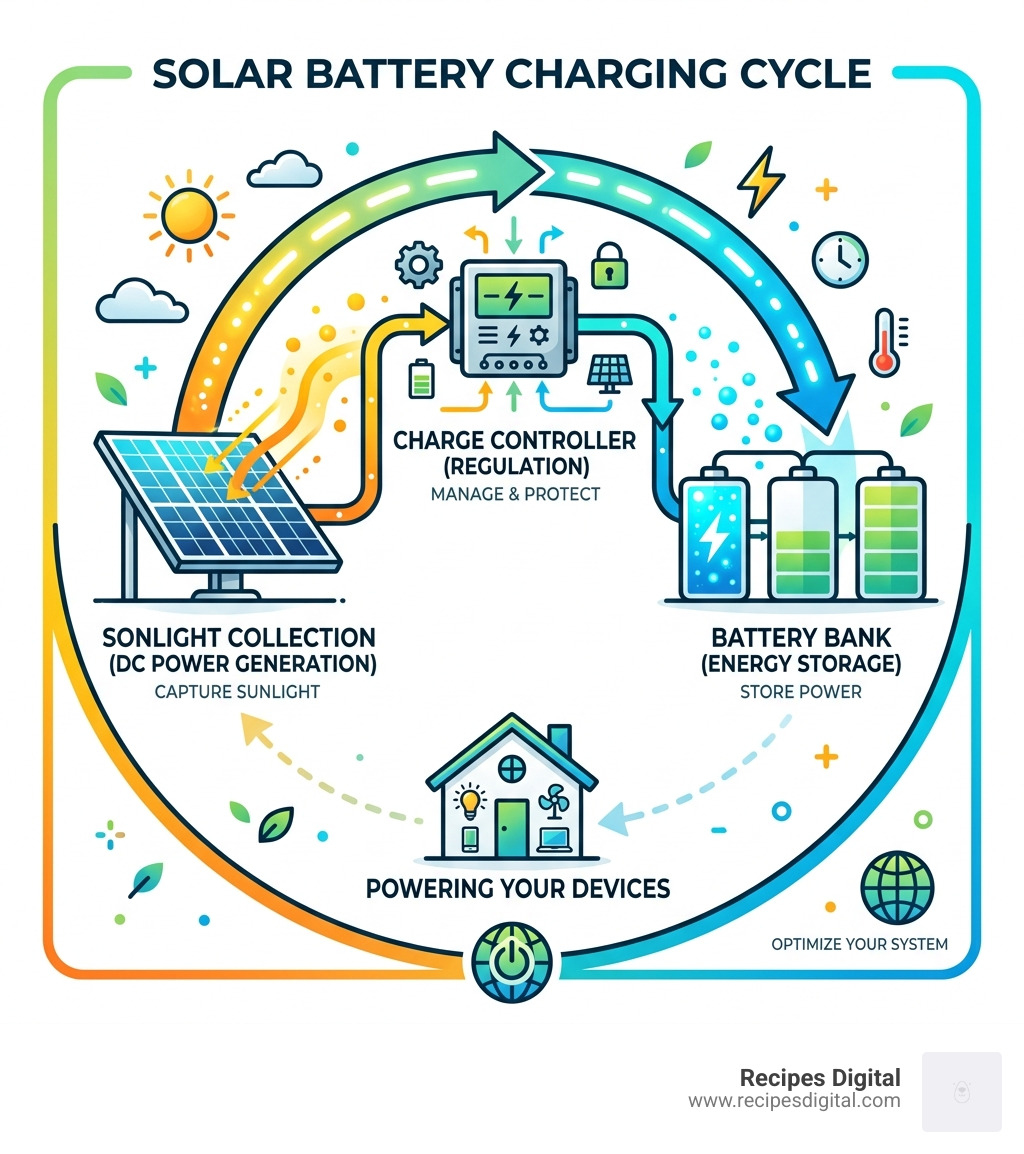
The charge controller is the “brain” between your panels and your battery. It prevents overcharging and regulates voltage.
- PWM (Pulse Width Modulation): These are older, cheaper, and less efficient. They essentially “clip” the panel’s voltage to match the battery, wasting the excess as heat. Expect 75-80% efficiency.
- MPPT (Maximum Power Point Tracking): These act like a smart transmission in a car. They take the high voltage from the panels and convert it into extra Amps for the battery. This provides a 15-30% energy harvest boost over PWM.
| Feature | PWM Controller | MPPT Controller |
|---|---|---|
| Efficiency | 75% – 80% | 94% – 99% |
| Best Use Case | Small systems (<100W) | Large systems, cold climates |
| Cost | Low | Moderate to High |
| Performance in Shade | Poor | Excellent |
Comparing Battery Chemistries: LiFePO4 vs. Lead-Acid
Not all batteries “soak up” solar energy at the same rate. This is one of the biggest variables in any solar battery charging calculator.
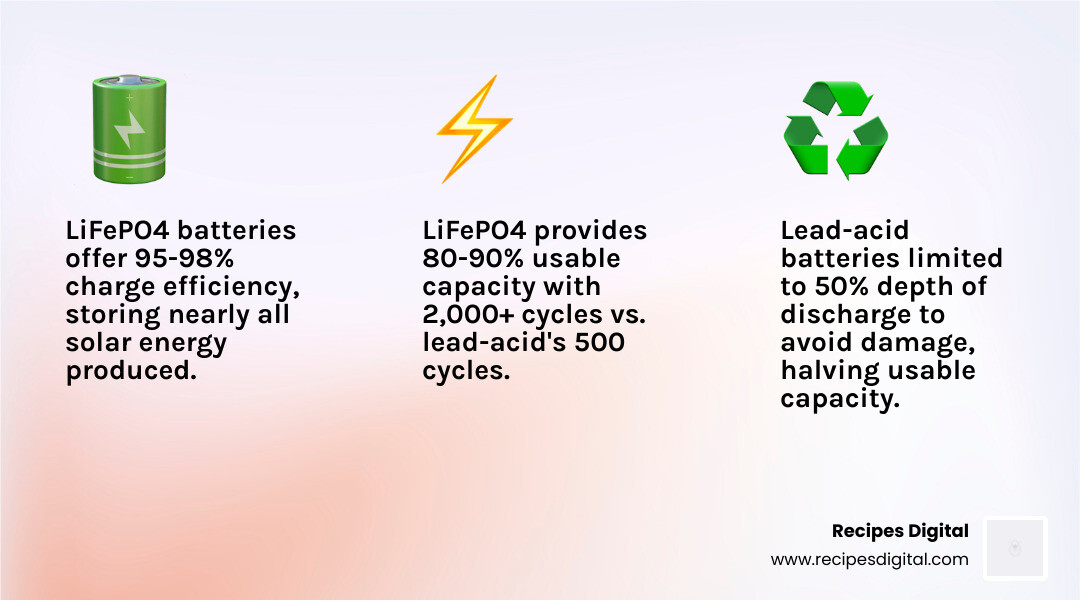
LiFePO4 (Lithium Iron Phosphate) Lithium is the gold standard for 2026. These batteries have a charge efficiency of about 95-98%. This means almost every drop of energy your panels produce actually makes it into the battery. They also don’t suffer from a slow “absorption stage” (see the FAQ below), meaning they can take high current all the way until they are nearly full. You can safely use 80-90% of their capacity.
Lead-Acid (AGM/Gel/Flooded) These are the old workhorses. They are cheaper upfront but less efficient (80-85%). The biggest drawback is the 50% DoD limit; if you use more than half the capacity, you damage the battery. They also charge very slowly once they hit 80% capacity, meaning you need more sun hours to get that last 20% than you did for the first 50%.
Frequently Asked Questions about Solar Battery Charging Calculators
Can I charge a battery directly from a solar panel without a controller?
Technically, yes, but you really shouldn’t. A solar panel’s voltage fluctuates wildly. A “12V” panel can actually output 18V to 22V. Without a controller to regulate this, you will likely “cook” your battery, leading to permanent damage or even a fire risk. A charge controller is a mandatory safety component for any system.
How does temperature affect my solar charging speed?
Temperature is a double-edged sword. Cold weather actually increases the voltage output of your solar panels, which can be a “boost” for MPPT controllers. However, lithium batteries cannot be safely charged below freezing (0°C/32°F) without internal heaters. If your battery is too cold, its internal resistance increases, and the charge rate will slow down significantly to protect the cells.
Why does the last 20% of charging take so much longer?
This is known as the Absorption Phase. When a battery (especially lead-acid) reaches about 80% State of Charge, it can no longer accept a high “bulk” current. The charge controller has to taper the current down to a trickle to push those last few electrons into the chemistry. It’s like trying to fill a water bottle: you can go full blast for the first few inches, but you have to slow down at the very top to avoid splashing.
Conclusion
Planning your solar journey doesn’t have to feel like a high school physics exam. By using a solar battery charging calculator, you can move forward with the confidence that your lights will stay on and your batteries will stay healthy.
The goal isn’t just to have power; it’s to have a balanced system where your panels, controller, and batteries work in harmony. Whether you are choosing between an MPPT controller or debating the switch to LiFePO4, data is your best friend.
Ready to dive deeper into optimizing your off-grid setup? Start your solar journey today with Recipes Digital, where we provide the modern resources you need for a sustainable, energy-independent lifestyle.
